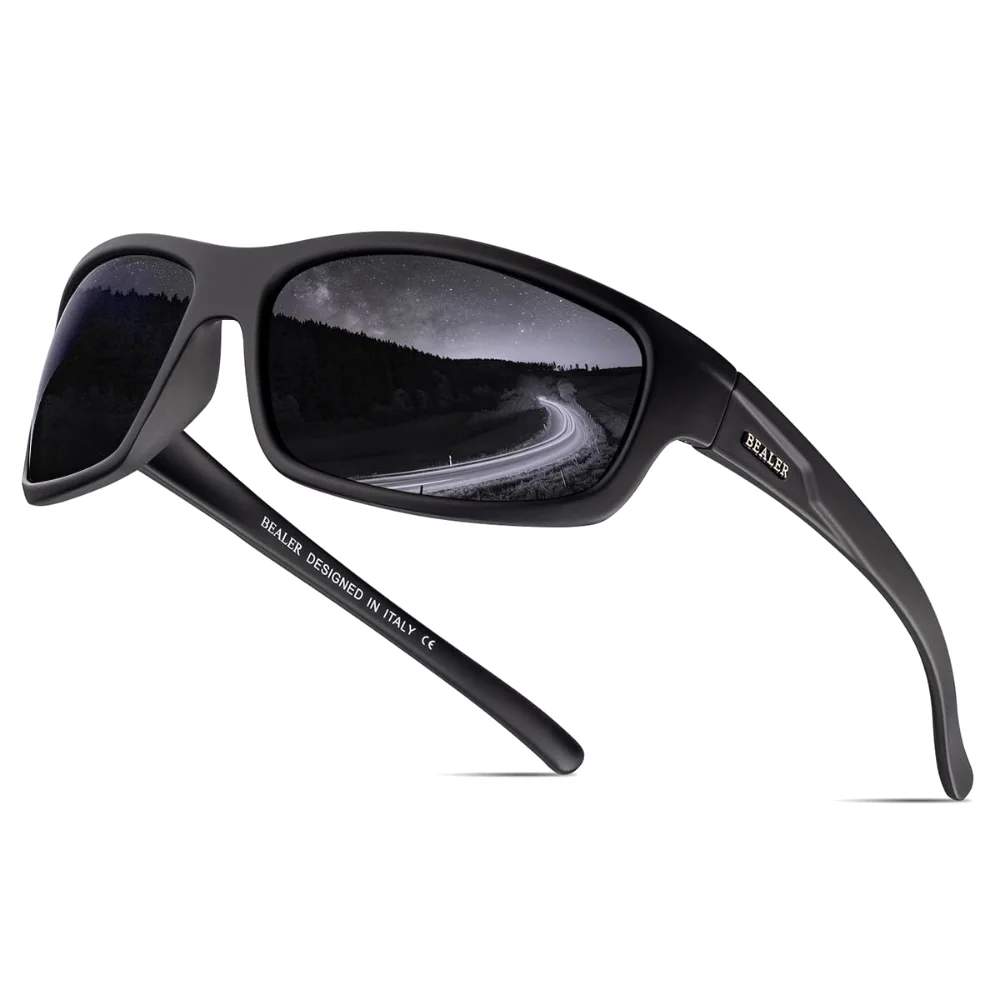
Sport wrap singles
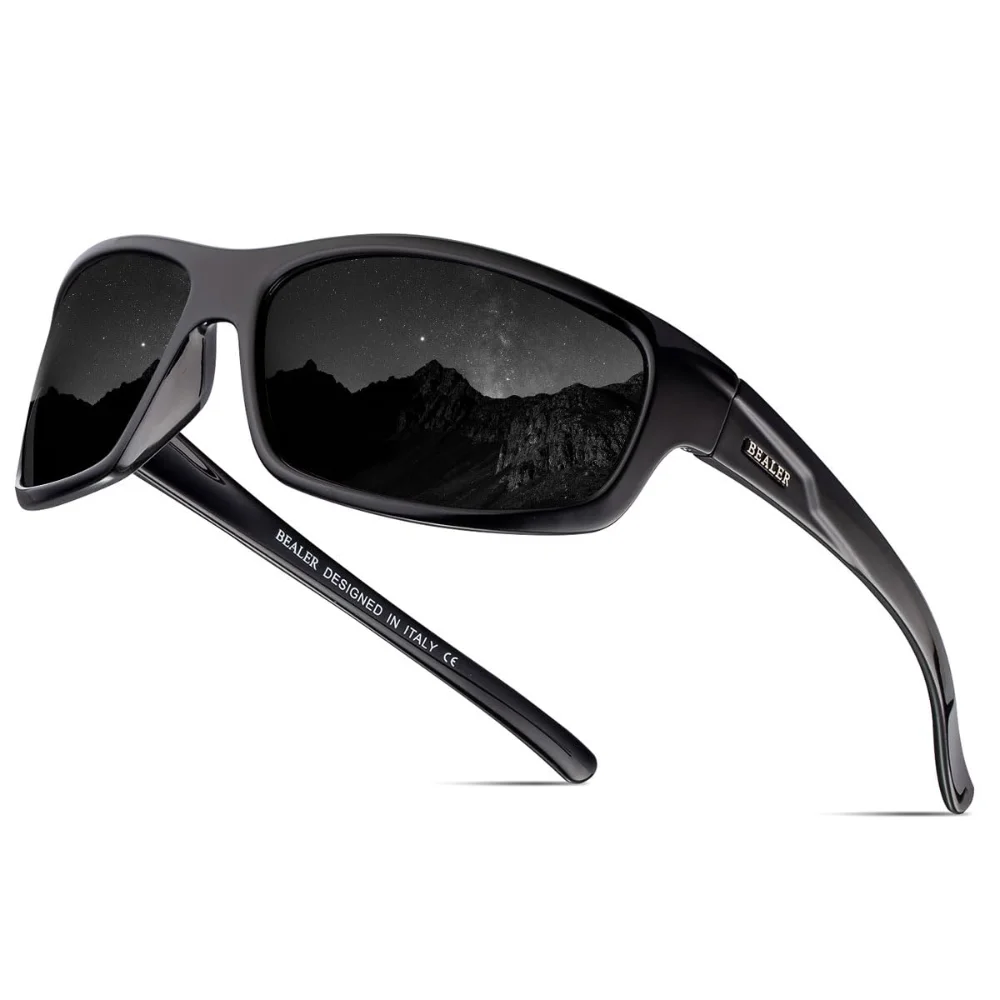
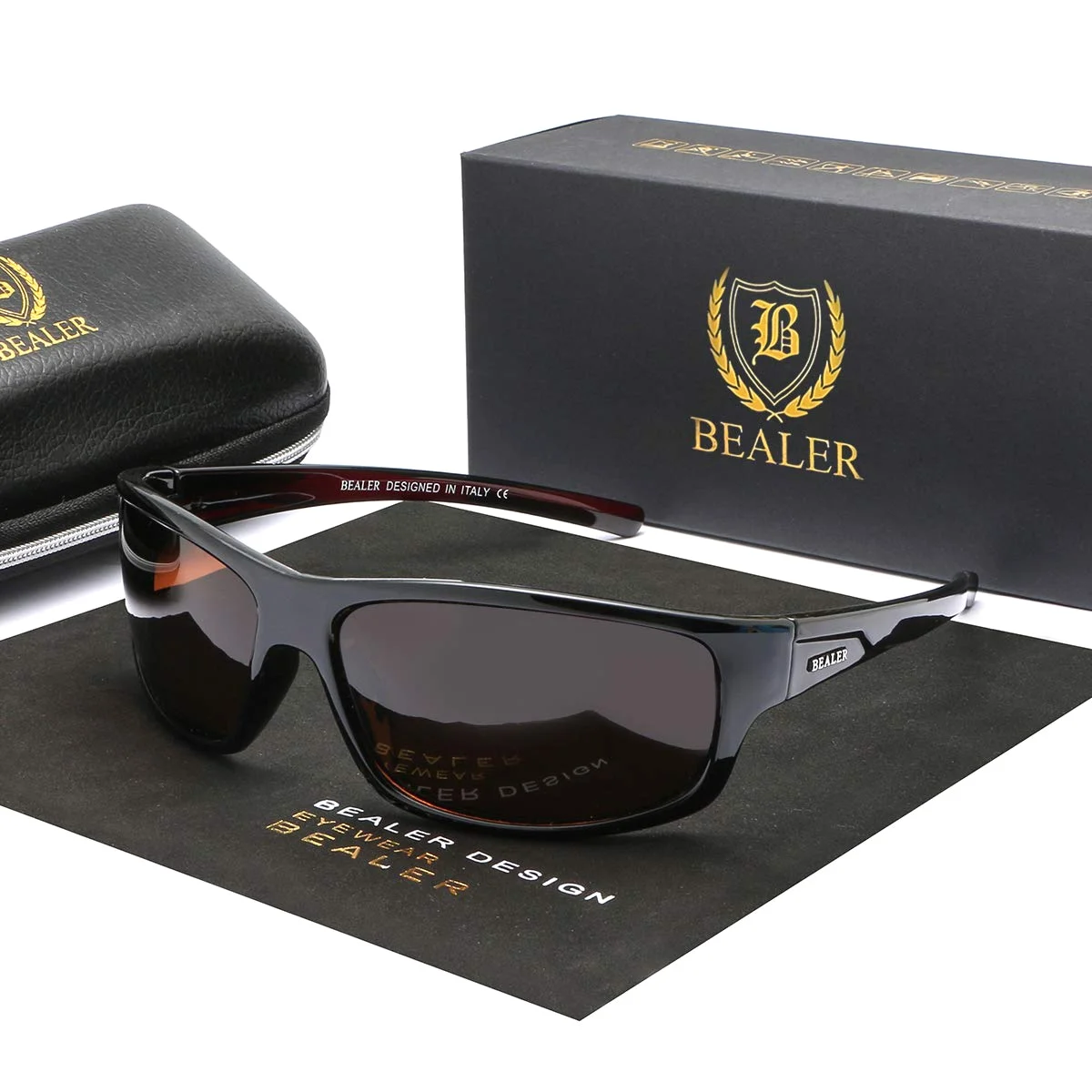
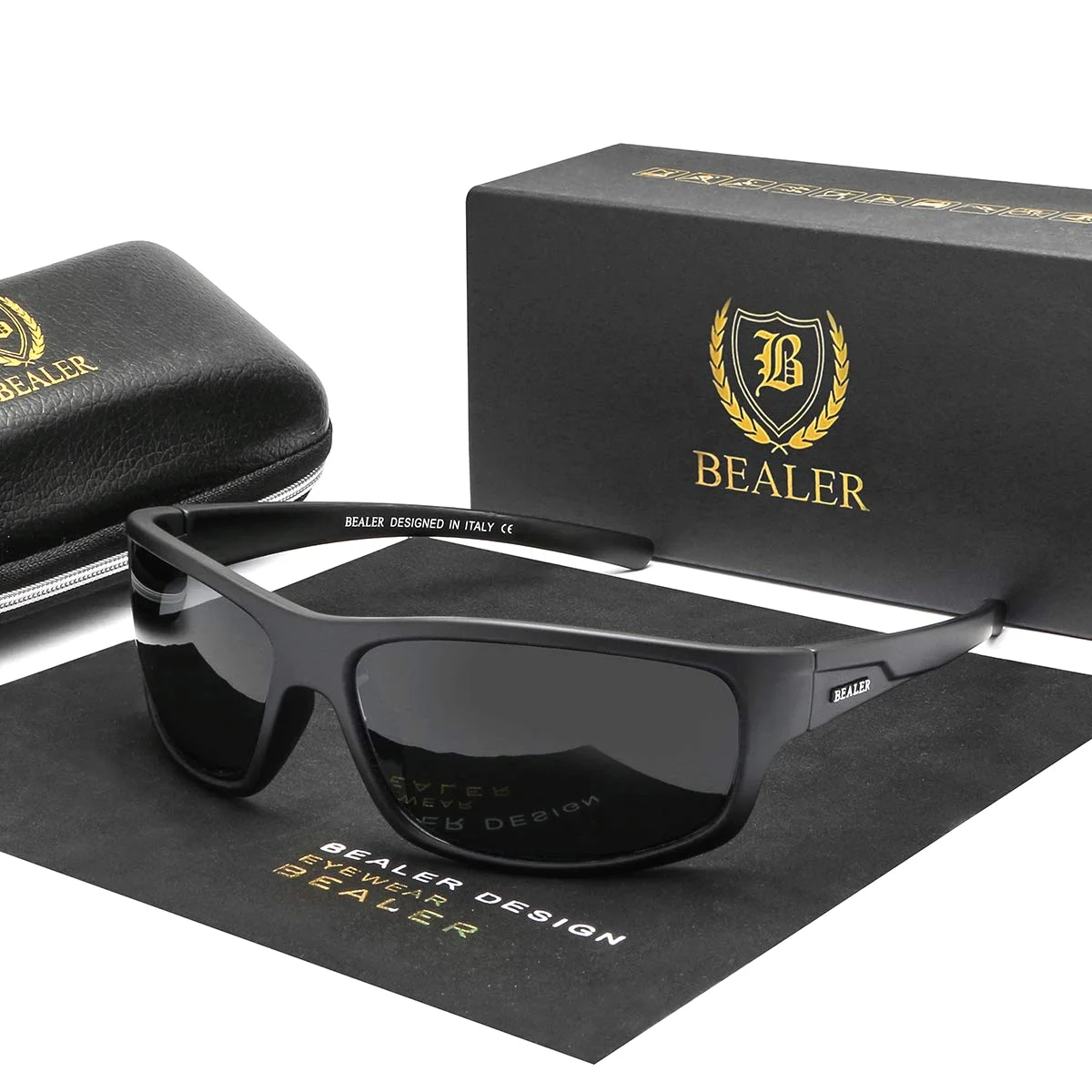
Sport Wrap BL6608, Matte Black / Grey
- Lens 62 x 37 mm, frame 137 mm
- TR90 nylon, polarized TAC lens, UV400
- Matte Black frame, grey lens
4.5 · 1,226 ratings
$11.99
01Sunglasses, sized in millimetres
A grey wrap for a lake at noon, a gradient brown rectangle for a windscreen, a frame that bends for a child who sits on it, a clear lens for a desk. Every pair here prints its lens width, its frame width and its lens rating before you decide anything.
Thirty-five pairs and packs across four shelves, from $9.99. Two-packs work out at $9.99 a pair, the children's three-packs at $3.33 to $4.00.

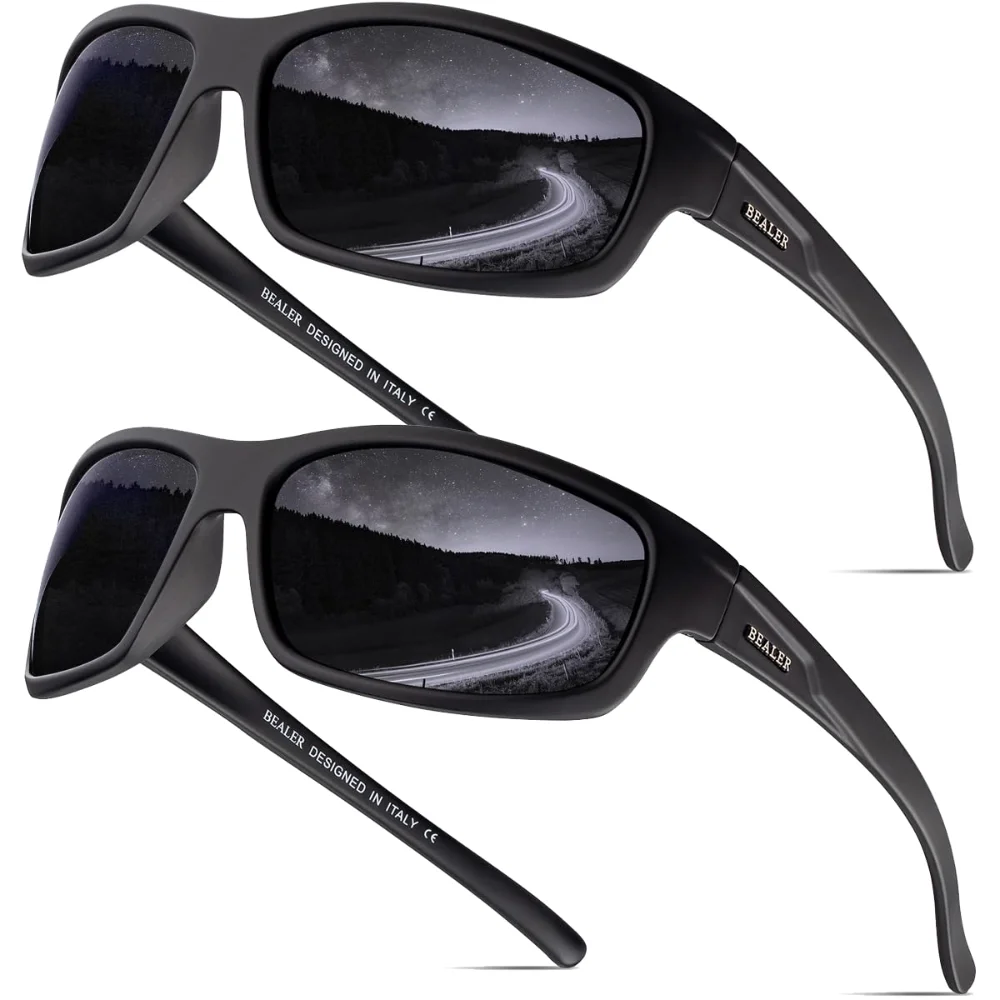
Sport Wrap BL6608 Two-Pack Z06, Matte Black/Grey and Glossy Brown/BrownLens 62 x 37 mm, frame 137 mm · $19.99
02Start with the light
A boat deck, a school run, a playground and a spreadsheet ask four different things of a lens. Pick the light you are standing in and the shelf sorts itself out; each card then tells you the millimetres.
Four shelves, one question asked four ways, and every lens on all of them belongs to the BEALER selection.
03What people reach for first
One pair from each family, ranked by how many people have rated it rather than by what we would like to move. Twelve hundred people have an opinion about the first one, and that is worth more than any adjective we could put beside it.
Sport wrap singles
4.5 · 1,226 ratings
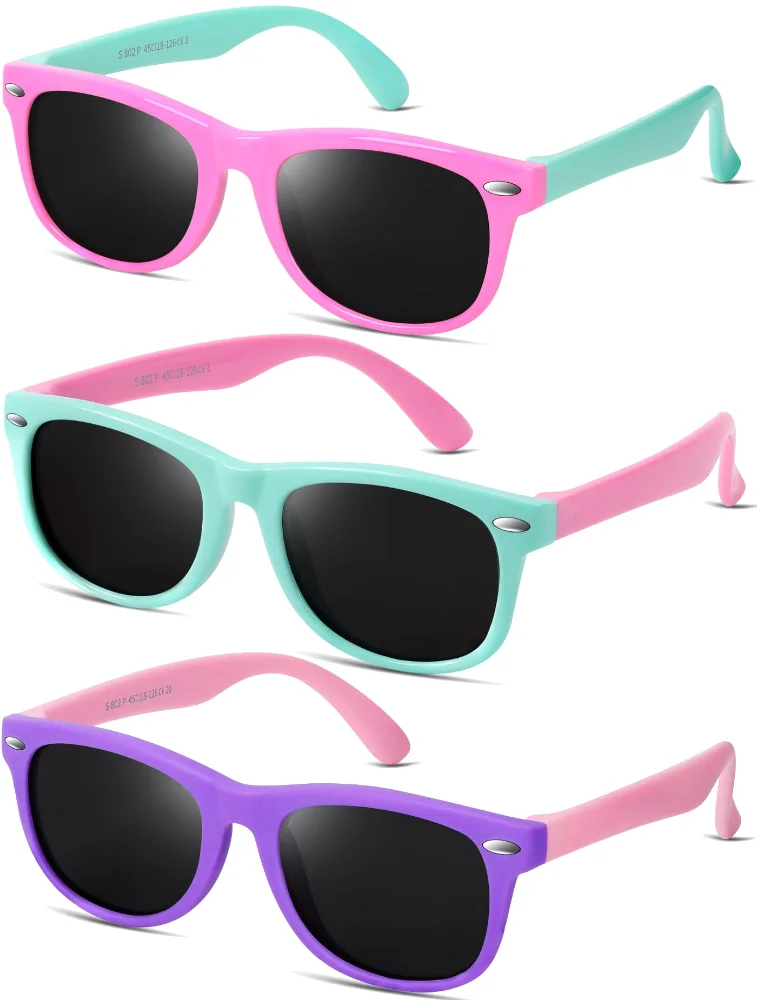
Kids flex three-packs
4.6 · 297 ratings
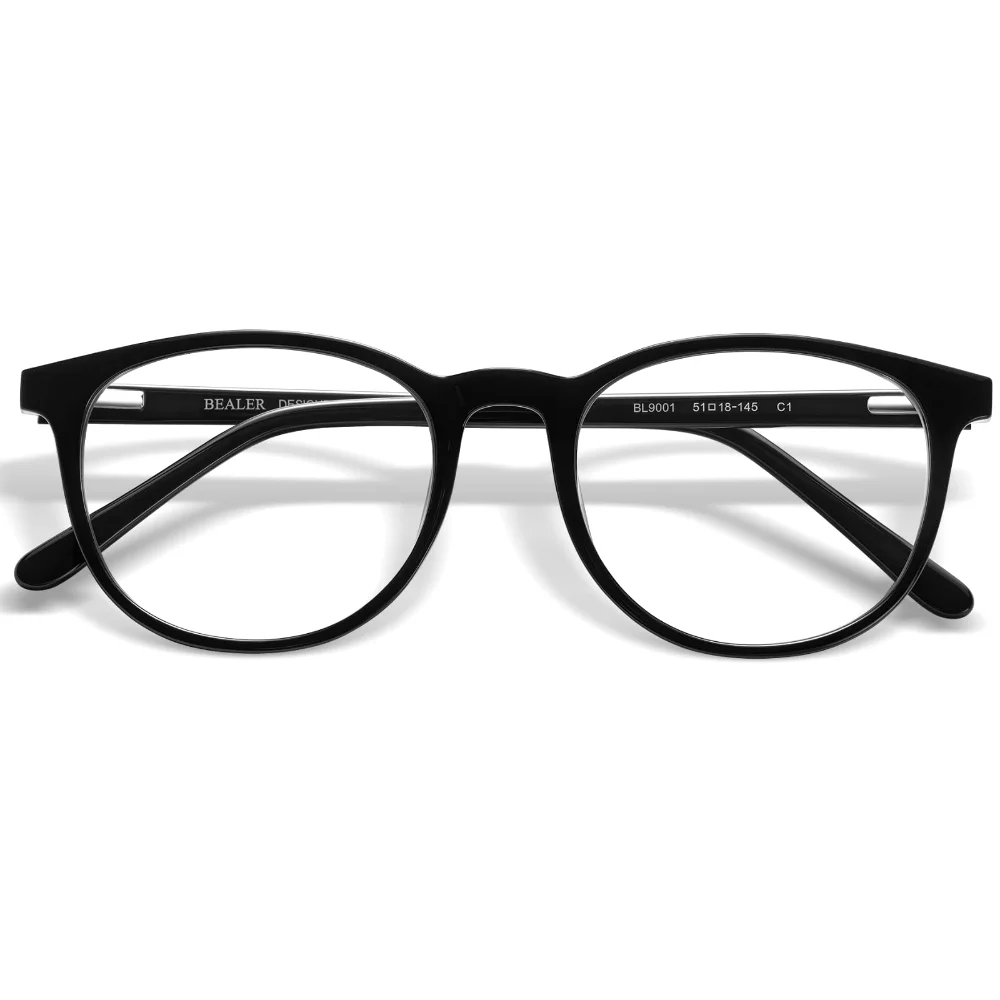
Round screen glasses
4.5 · 55 ratings
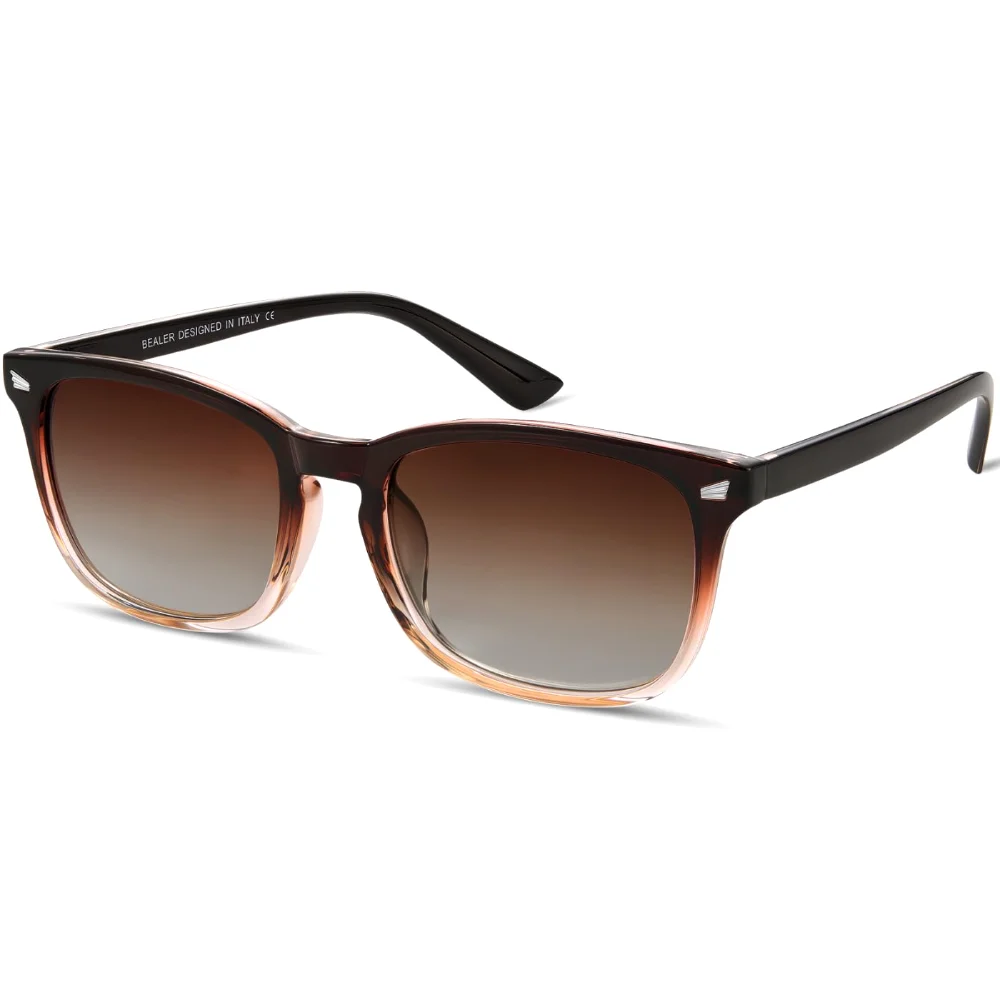
Retro rectangle singles
4.1 · 37 ratings
04What a polarized lens is doing
Stand at the edge of a lake at noon and the water is white. Not bright: white, a sheet of it, and the fish and the rocks under it are gone.
That sheet is not sunlight so much as sunlight bounced. Light coming off a flat surface, water, a wet road, the bonnet of the car in front, arrives lined up in one plane, and a polarizing film is a grid tuned to stop exactly that plane. The sky comes through. The bounce does not. The lake goes back to being water with a bottom.
You can check it in the shop or in your kitchen. Hold the lens up to a phone screen and turn it: at one angle the screen goes dark, because a screen is polarized too. That is the same effect that makes a car dashboard or a cash machine hard to read through these lenses, and it is why the academy of ophthalmology says a polarized lens is the wrong lens for driving at night.
What the film does not do is stop ultraviolet light. That job belongs to a separate rating on the lens, UV400, which means the lens is built to stop wavelengths up to 400 nanometres, the top of the UVA band. Every sunglass lens on these shelves carries both, and the card says so; a lens with only one of them is doing half the job.
A darker tint is not a safer lens, a polarized lens is not a UV lens, and a lens rated for blue light is a clear lens with a coating. Where a sentence here touches your eye rather than your view, we quote the American Academy of Ophthalmology, the American Optometric Association, the CDC or the FDA, with a link and the date we read it.

05On water and road
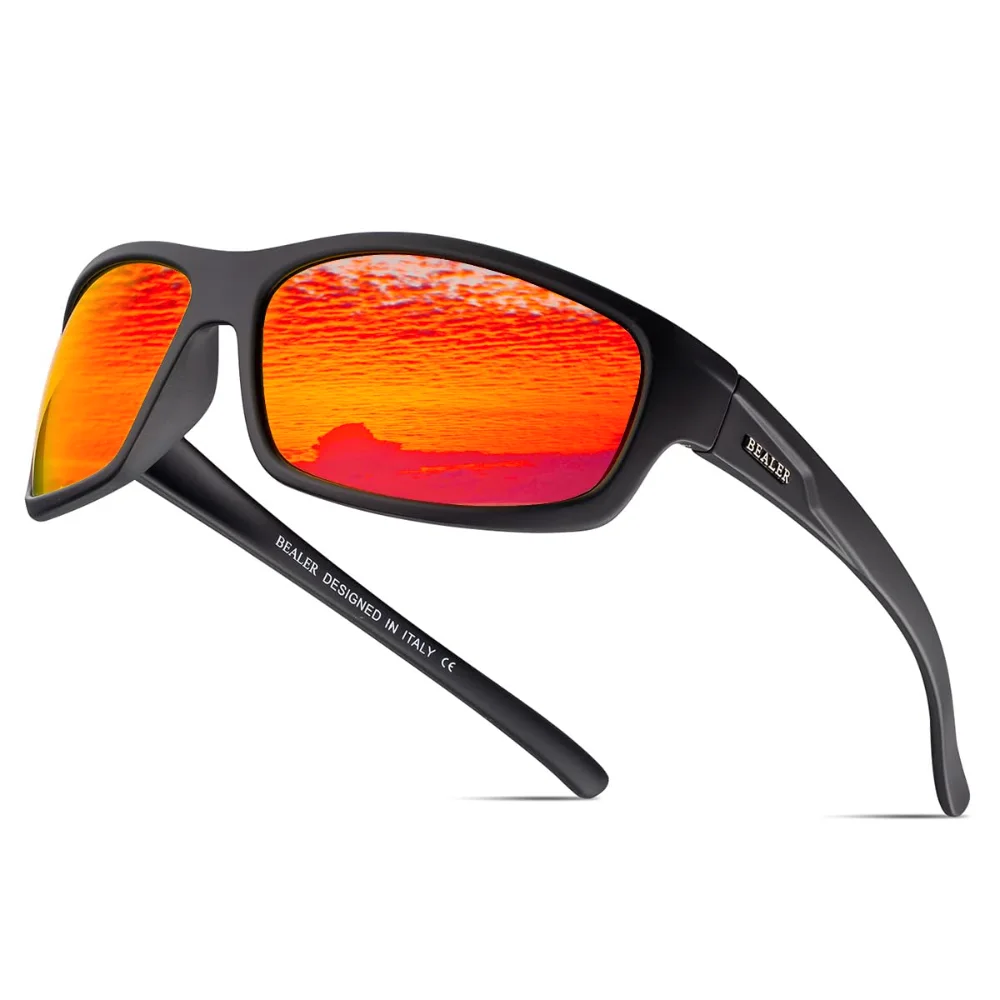
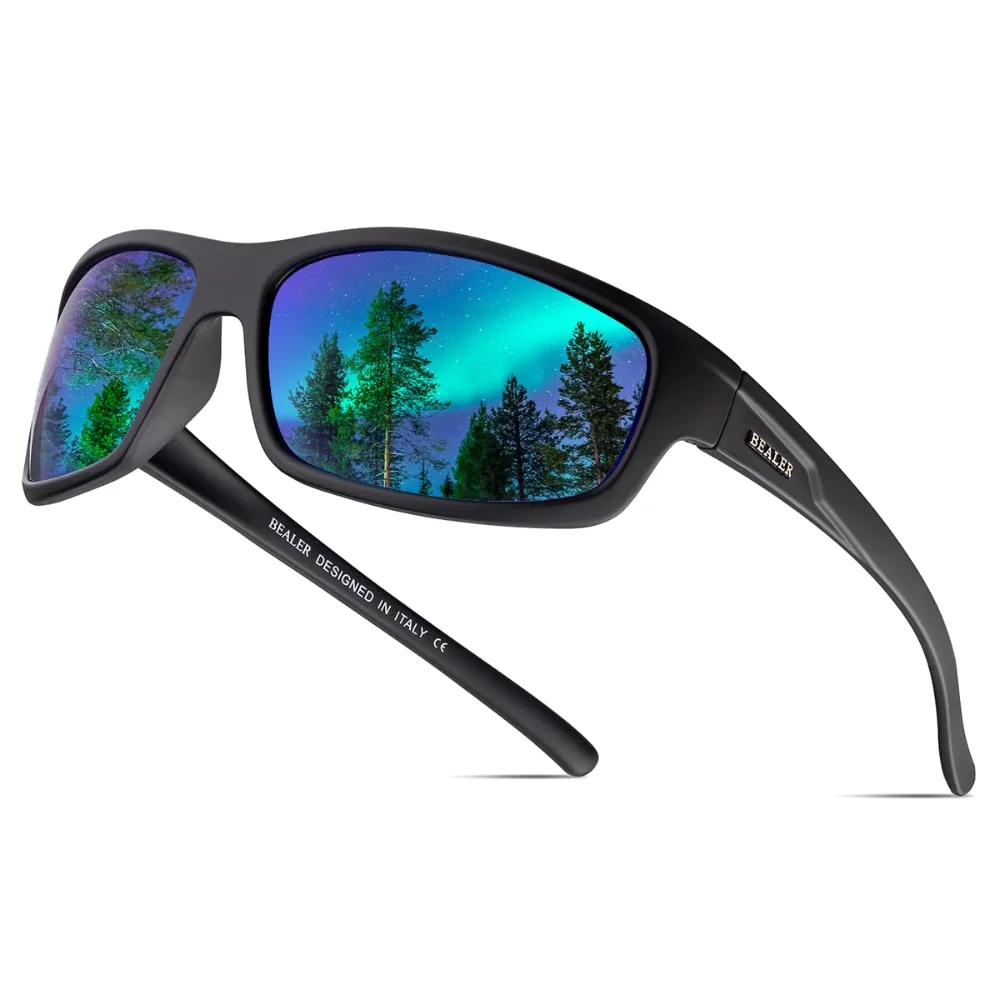
The same 62 mm lens and 137 mm TR90 frame under five tints and two finishes. Grey first, then the mirror coats for open water, then orange for the day the road has no contrast in it; the two-packs put two of them in one box at $9.99 a pair.
Sport wrap singles
4.5 · 1,226 ratings
Sport wrap singles
4.5 · 1,226 ratings
Sport wrap singles
4.5 · 1,226 ratings
Sport wrap two-packs
4.5 · 1,226 ratings
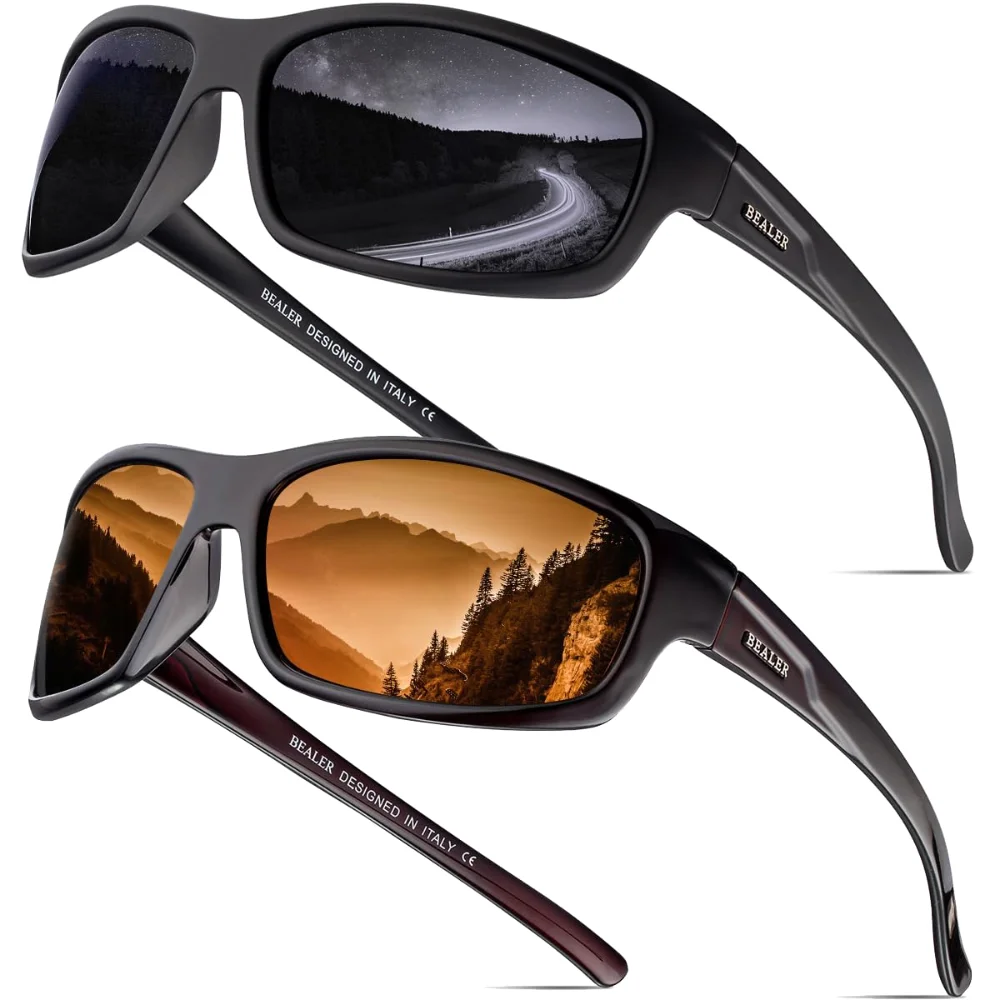
Sport wrap two-packs
4.5 · 1,226 ratings
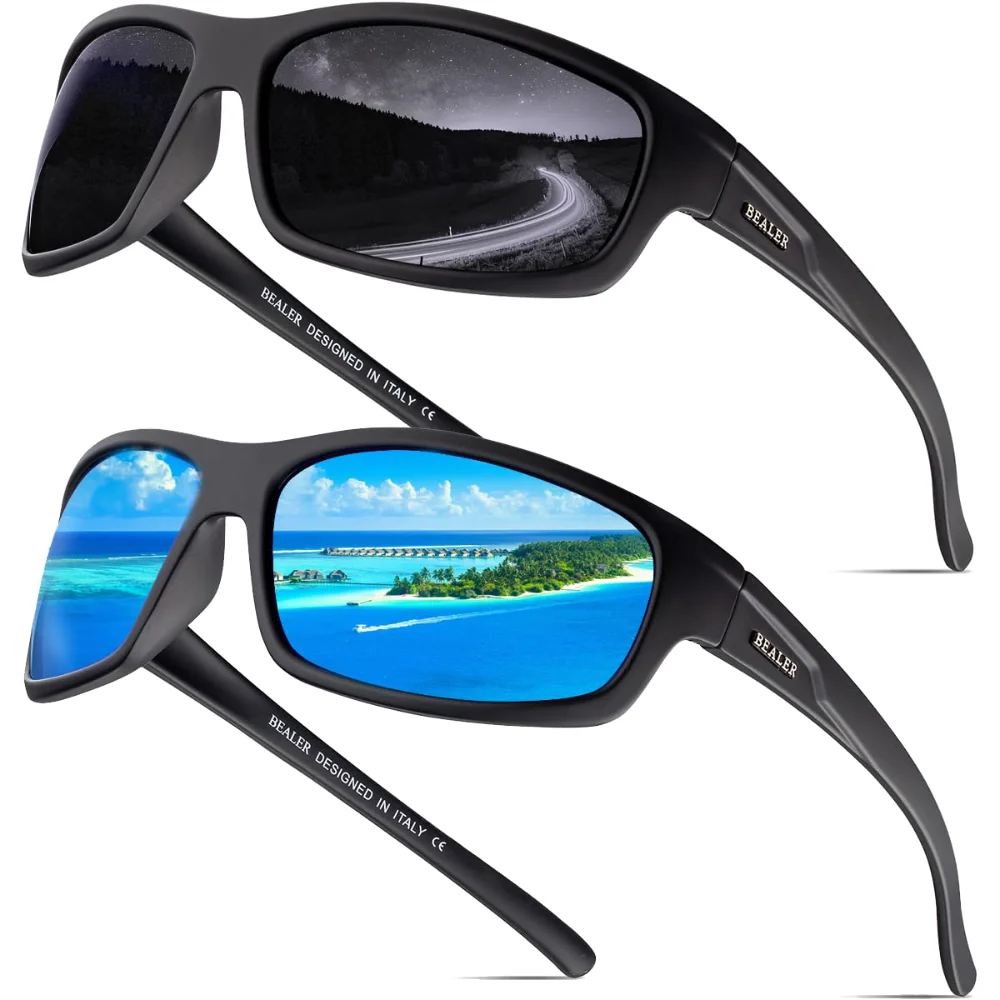
Sport wrap two-packs
4.5 · 1,226 ratings
06On a face, and off it
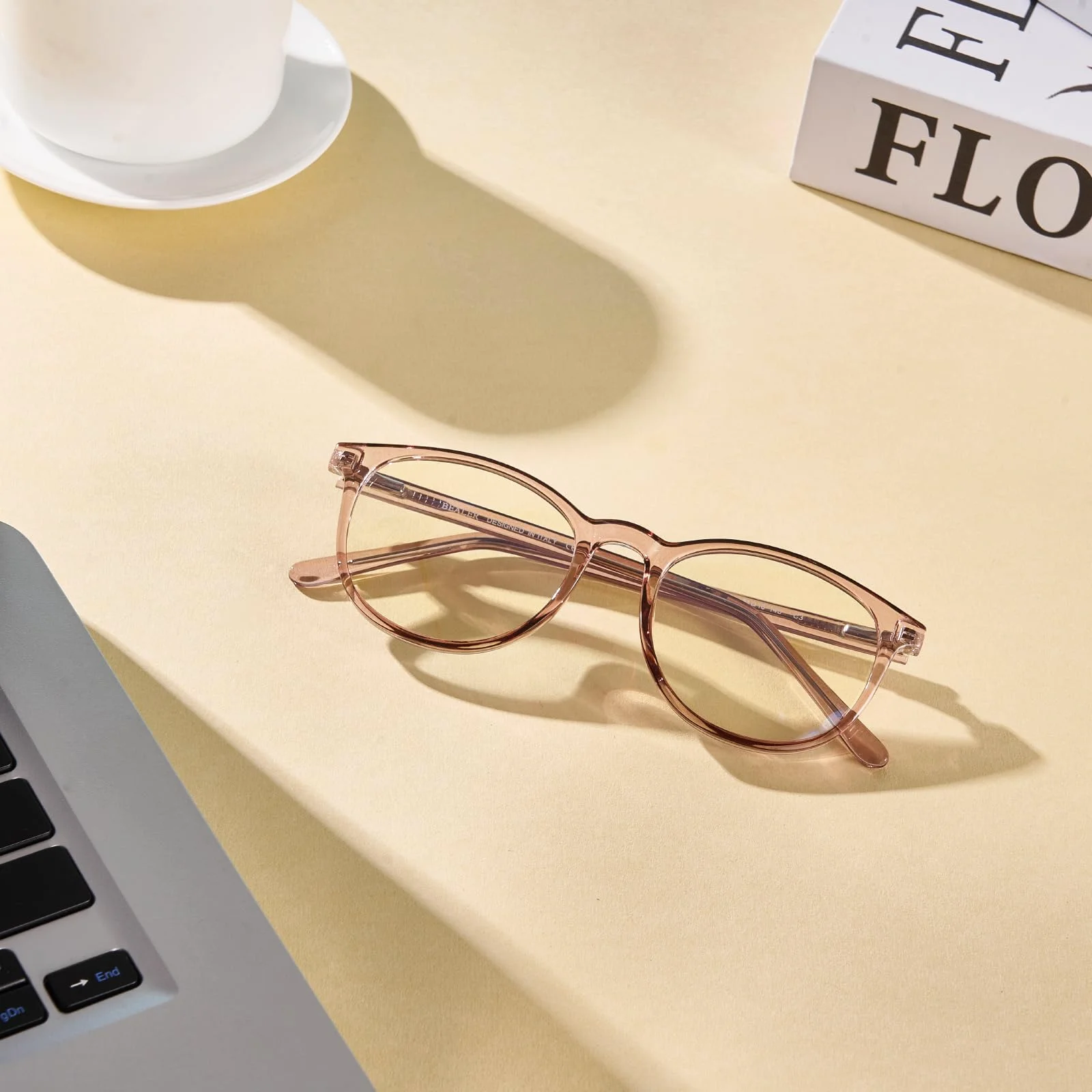
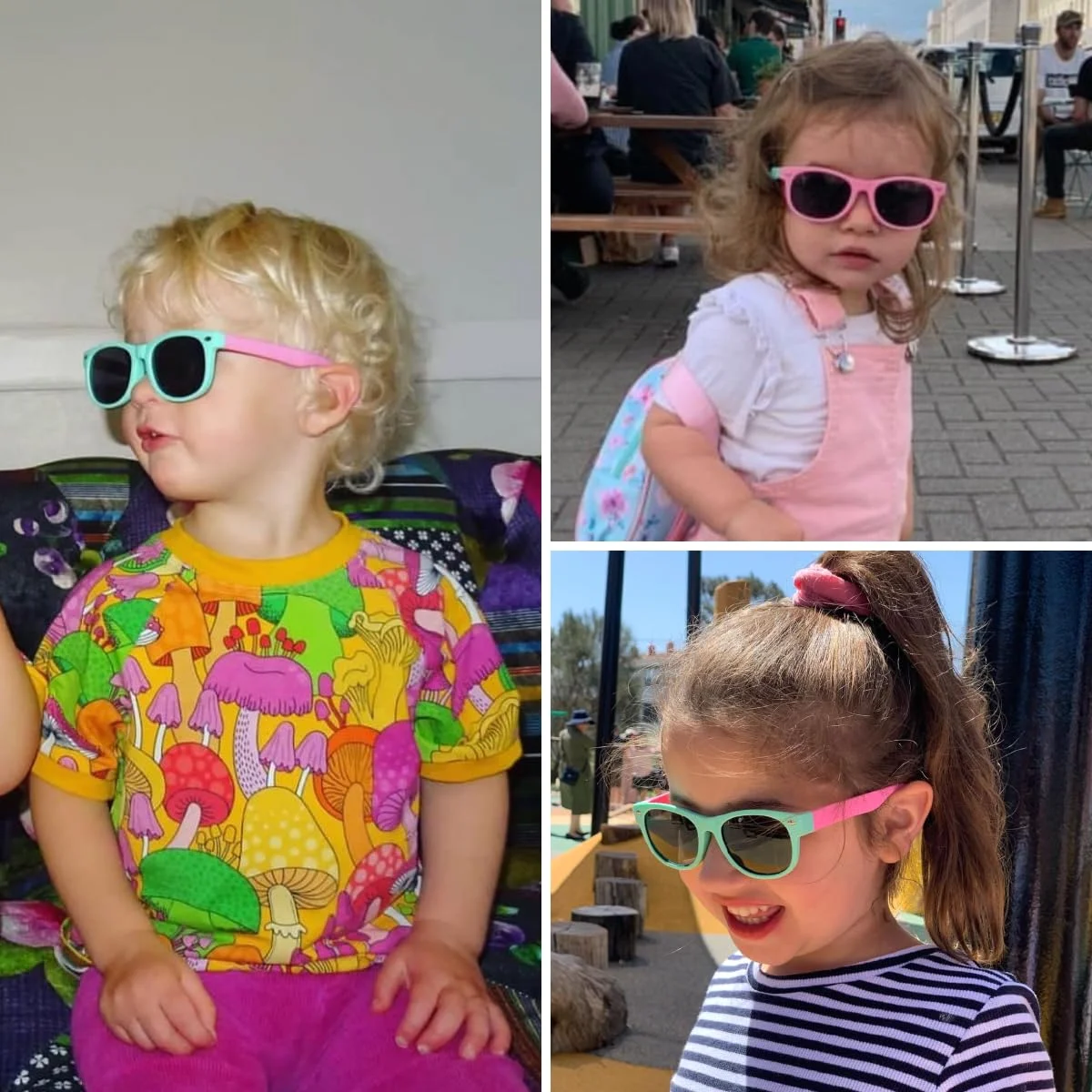
A pack shot tells you the colour of the frame. These are the same frames on a man in a green shirt, on a woman in white, on three children who have already dropped theirs once, and beside a laptop at four in the afternoon.


07What each part is made of
A frame is three decisions made in plastic: how it bends, how much it weighs on the bridge of your nose, and what happens when it hits the floor. The four materials on these shelves answer those three questions differently, and the card names which one you are holding.
The frame of the sport wrap and the screen glasses. A nylon that flexes and returns, light enough that a 137 mm wrap sits on the nose for a day of fishing without leaving a mark. It takes a knock by bending rather than cracking.
The frame of the women's rectangle. Rigid, light and the material the ophthalmologists name when they talk about lenses that have to survive sport; here it is the frame, and the metal hinge inside it is what keeps the arms tight.
The children's frame. A soft thermoplastic that folds flat and comes back, because a three-year-old does not take glasses off, they pull them off. Bendable is not the same word as unbreakable, and we use the one that is true.
The lens itself, on every sunglass pair here: a 1.1 mm laminate with the polarizing layer inside it and a UV400 rating. The men's lens is rated to absorb 85% of visible light; the tint decides how the world is coloured, the rating decides what reaches your eye.
| Lens | Where it is on the shelves | What it does to the view | Where it is the wrong choice |
|---|---|---|---|
| Grey | The sport wrap in four finishes, the women's orange tortoise, every children's pair | Cuts brightness without shifting colour; a red light stays red | Low light, dusk, indoors |
| Gradient brown | Most of the women's rectangles, single and in threes | Warms the view and lifts contrast; darker at the top of the lens where the sky is | Anywhere colour has to be judged exactly |
| Blue and green mirror | The sport wrap and its two-packs | A mirror coat on a grey base that throws back more of the light before the tint starts | A day that clouds over: the view goes dim fast |
| Orange and pink mirror | The sport wrap orange, the women's clear frame with pink | Brightens a flat grey day and pulls detail out of shadow | Full sun on water, where the extra brightness works against you |
| Clear with a blue-light coating | The three screen glasses | No tint at all: a plain lens with a coating that reflects part of the blue band | Outdoors in sun, where it stops no glare and carries no UV rating of its own |
Nothing in the BEALER way asks one lens to do two jobs, which is why the tint and the rating sit on the card as two separate words.
08Passenger seat and playground
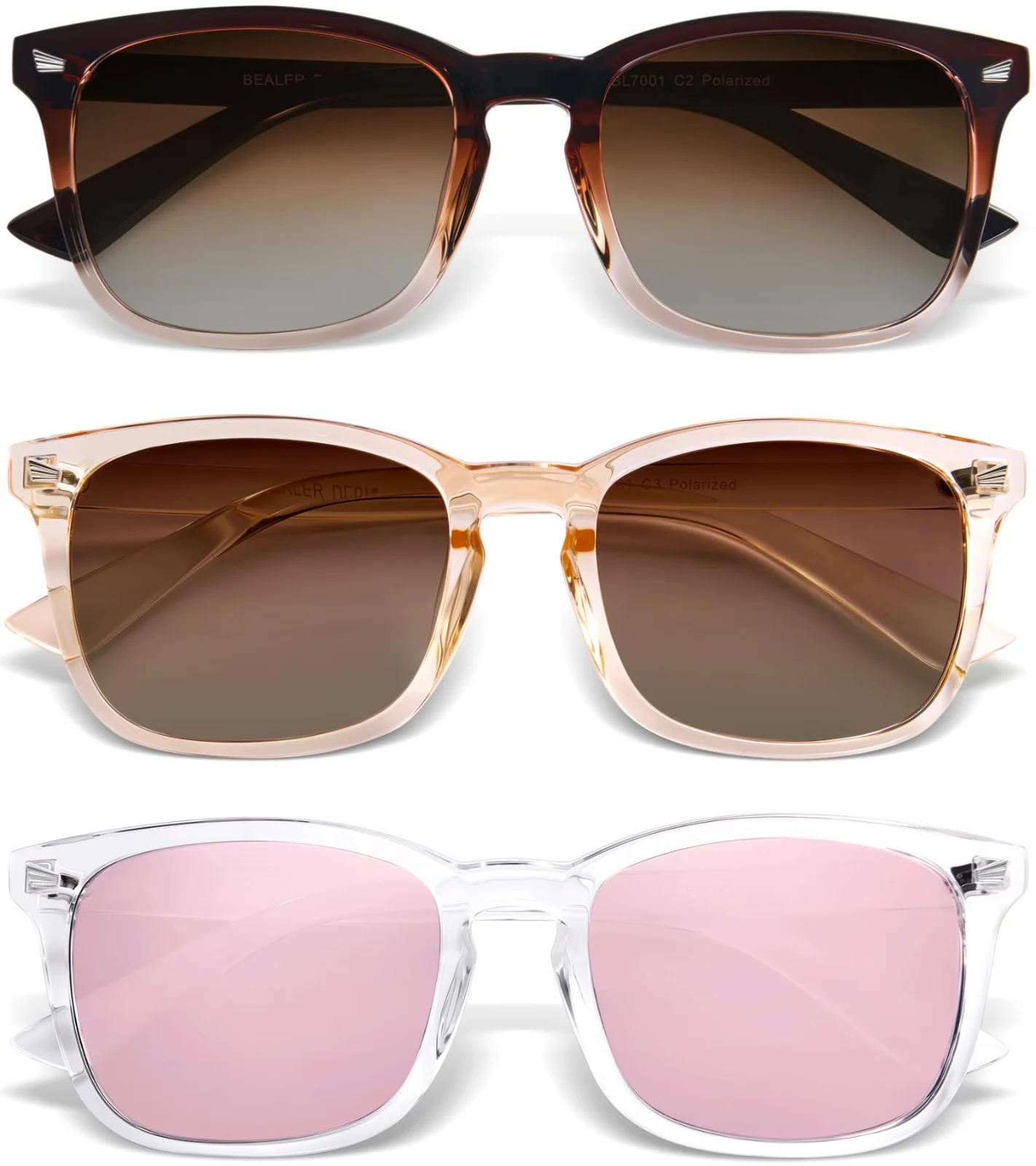
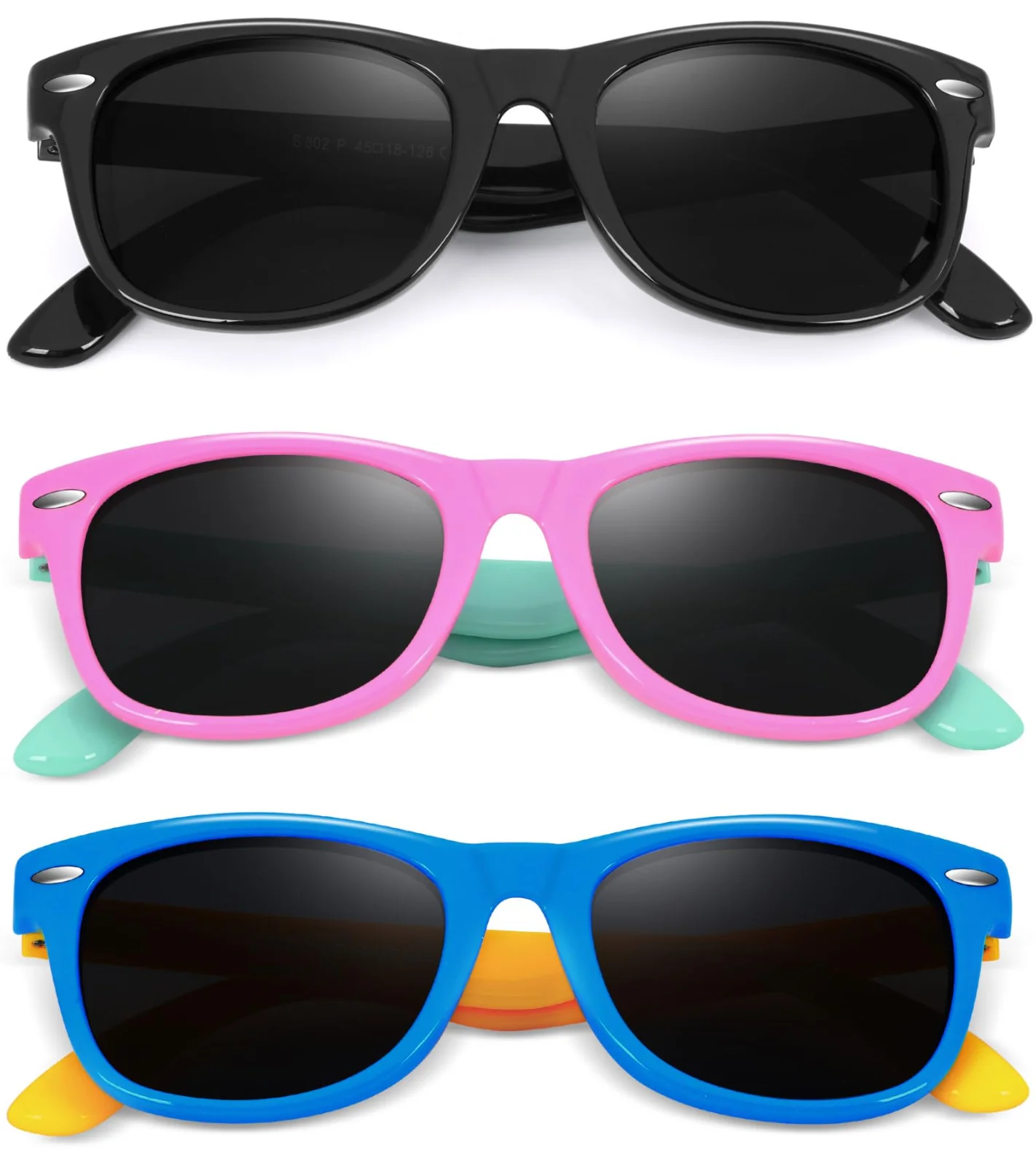
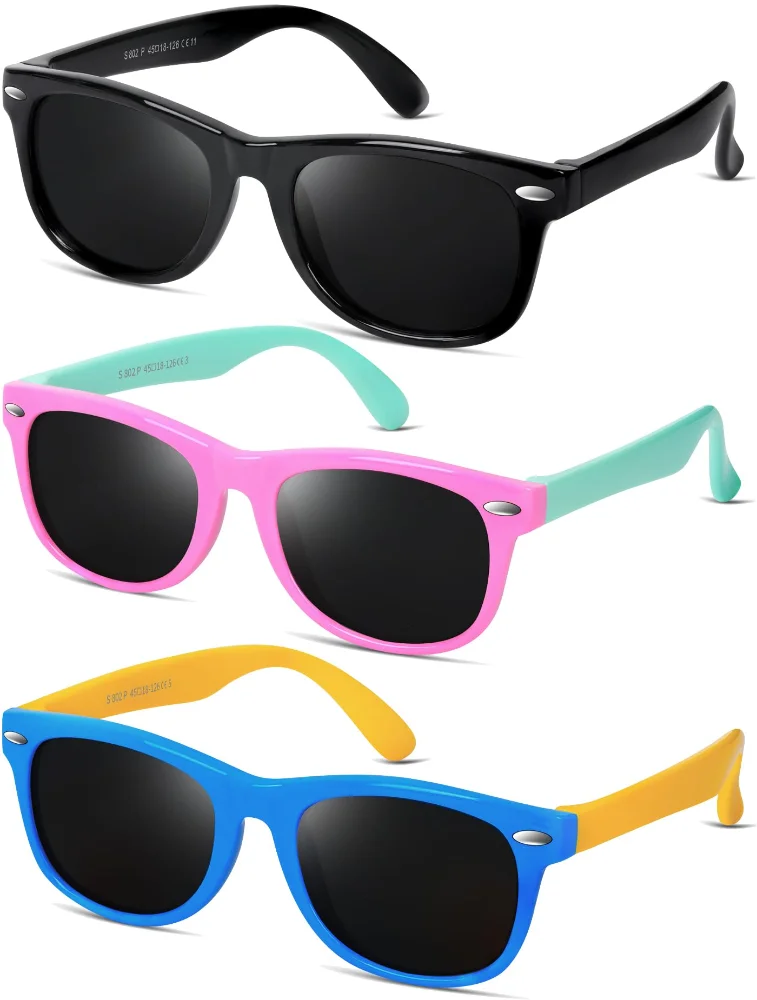
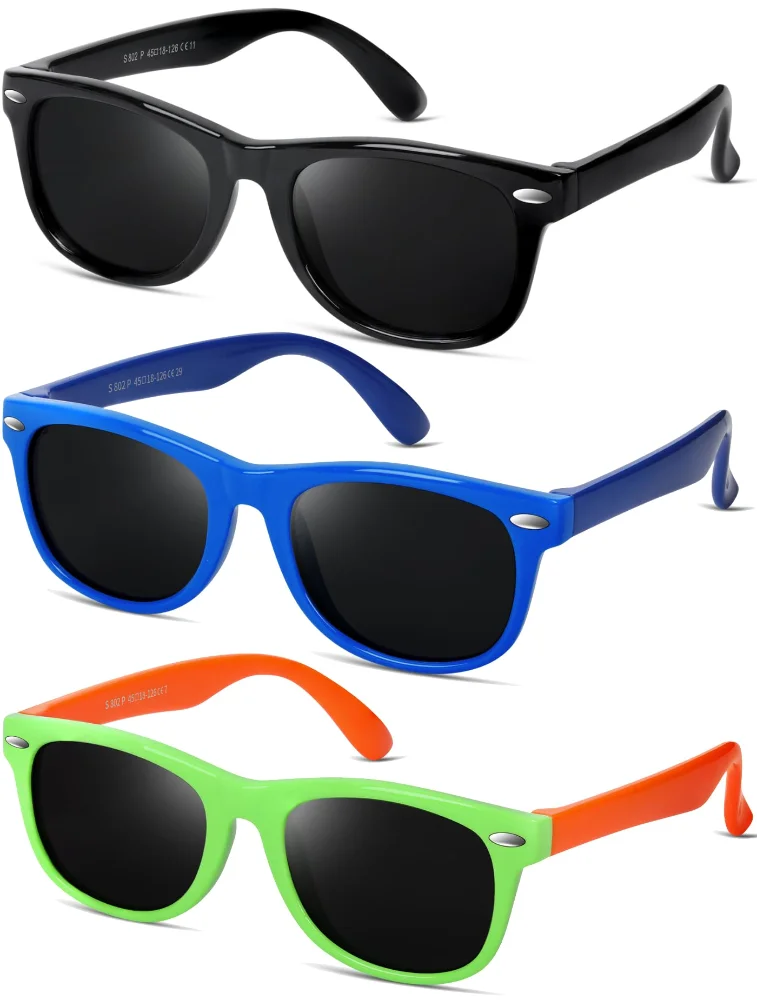
A 52 mm rectangle with a lens tall enough to keep the sky out of a windscreen, and a 45 mm frame that bends for a child who will sit on it. Every card prints the millimetres, because a frame that arrives two sizes off is a frame you give away.
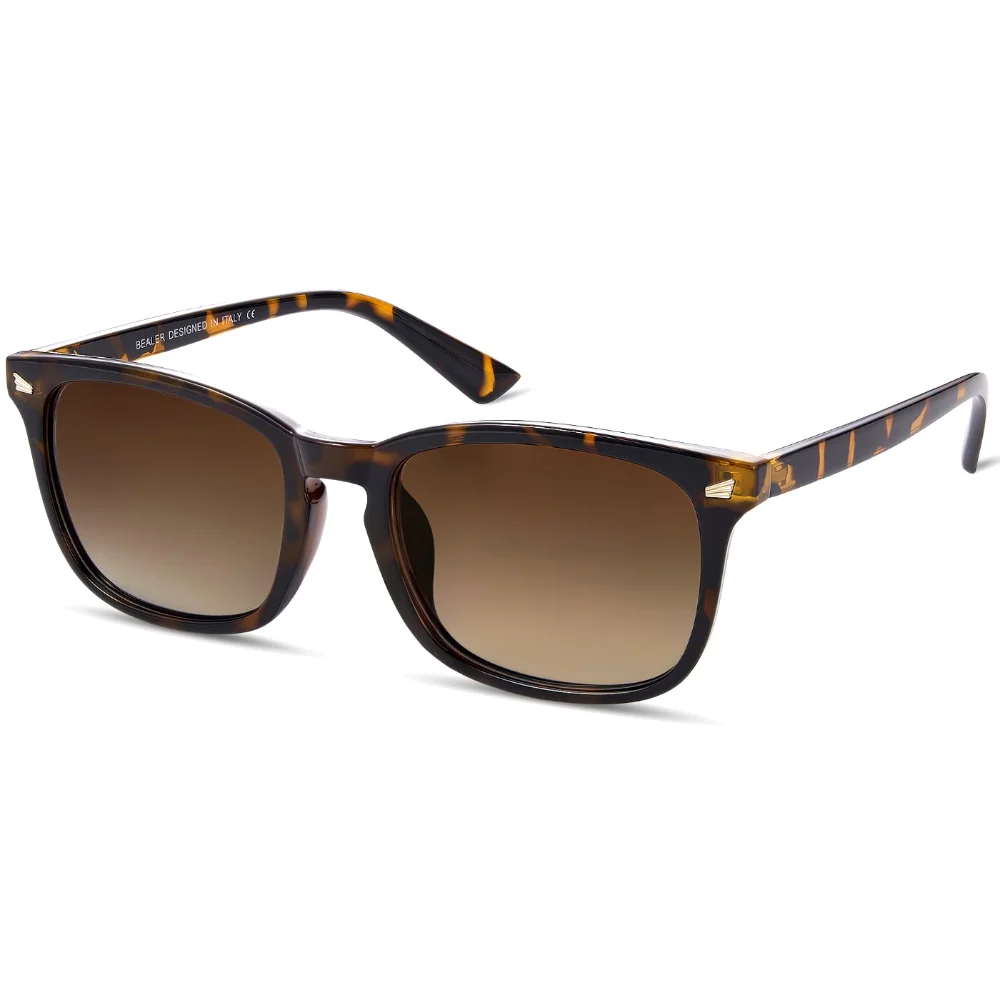
Retro rectangle singles
4.1 · 37 ratings
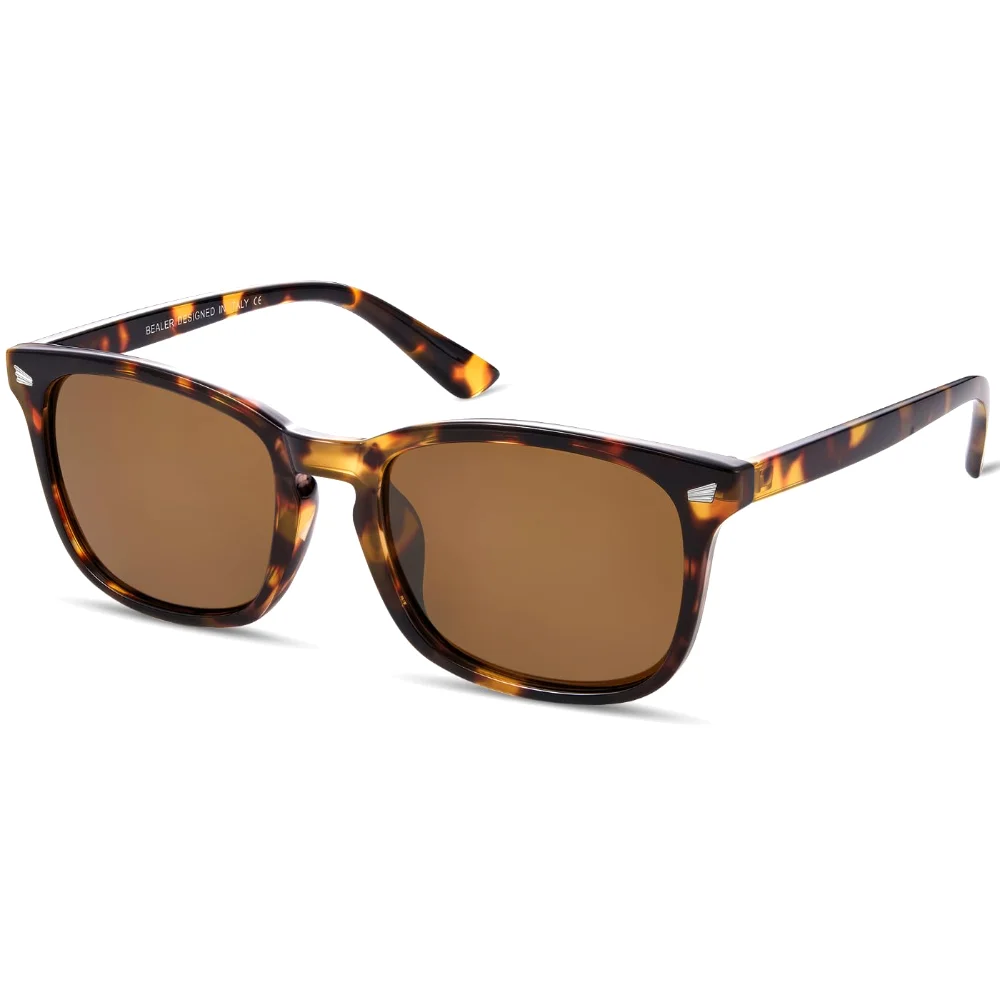
Retro rectangle singles
4.1 · 37 ratings
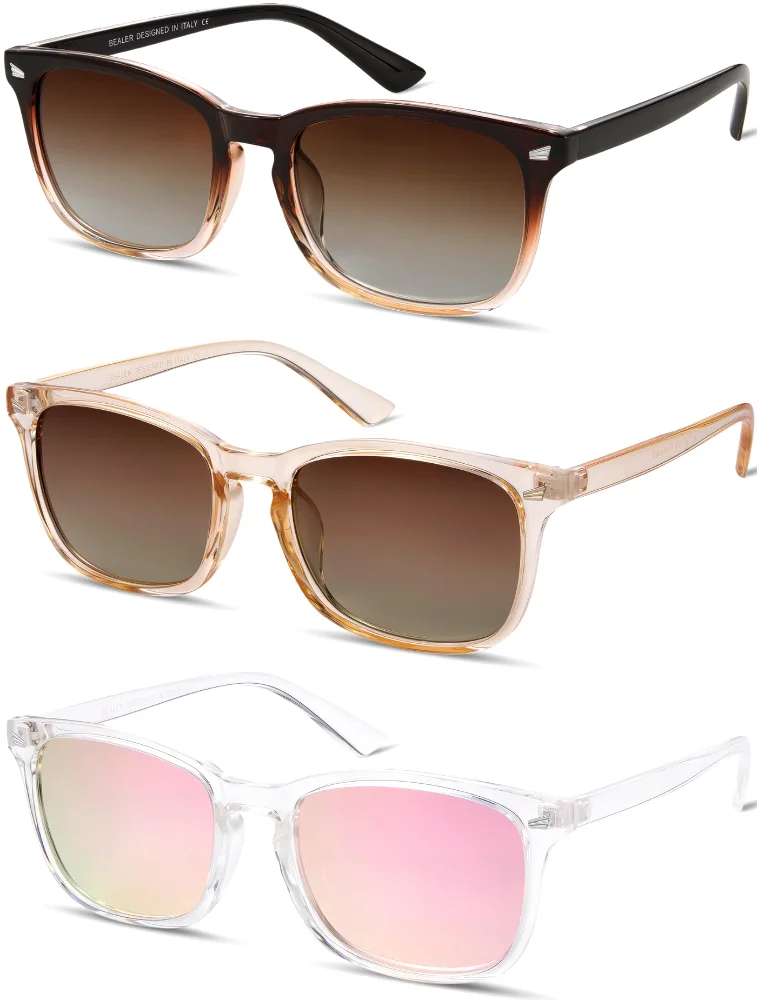
Retro rectangle three-packs
4.1 · 37 ratings
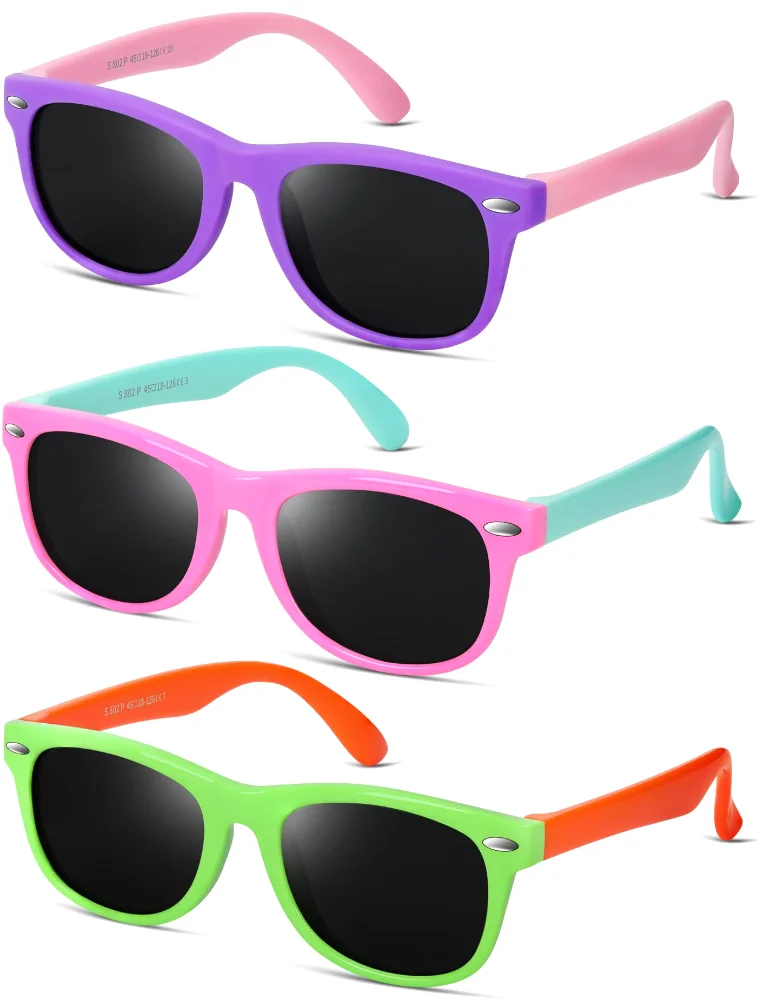
Kids flex three-packs
4.6 · 297 ratings
Kids flex three-packs
4.6 · 297 ratings
Kids flex three-packs
4.6 · 297 ratings
09Against the alternatives
There are only so many answers to a road that turns white at four in the afternoon, and most people have tried three of them. Here they are side by side, including the two that cost nothing.
| The answer | What it does well | What it costs you | Honest verdict |
|---|---|---|---|
| Squint, or pull a cap down | Free, always with you | Nothing about the light changes; the glare off the road is still there and the ultraviolet is still arriving | Fine for a minute, tiring for an hour |
| A dark lens with no rating on it | Cheap and it looks the part | The academy is blunt: a darker lens is not a safer lens, and a pupil opened wide behind an unrated tint lets more UV in, not less | The one answer that can be worse than nothing |
| A tinted prescription lens | Corrects your sight and shades it in one pair | A second full pair to buy and to lose, and a clear pair still needed indoors | Right if you need correction; the rest of us do not |
| A polarized lens, unrated for UV | Kills the glare off water and road | Polarization on its own provides no UV protection, in the academy's words; you have solved the view and not the eye | Half a lens |
| A polarized lens with a UV400 rating | Glare gone, UVA and UVB stopped, colour left alone in grey or warmed in brown | You still have to read the numbers: lens width, frame width, and whether a screen matters to you that day | What every sunglass pair on these shelves is, and why the cards print millimetres |
The bottom row is where the BEALER catalogue lives, and the first row is worth trying for a minute before you spend anything at all.
10At a desk
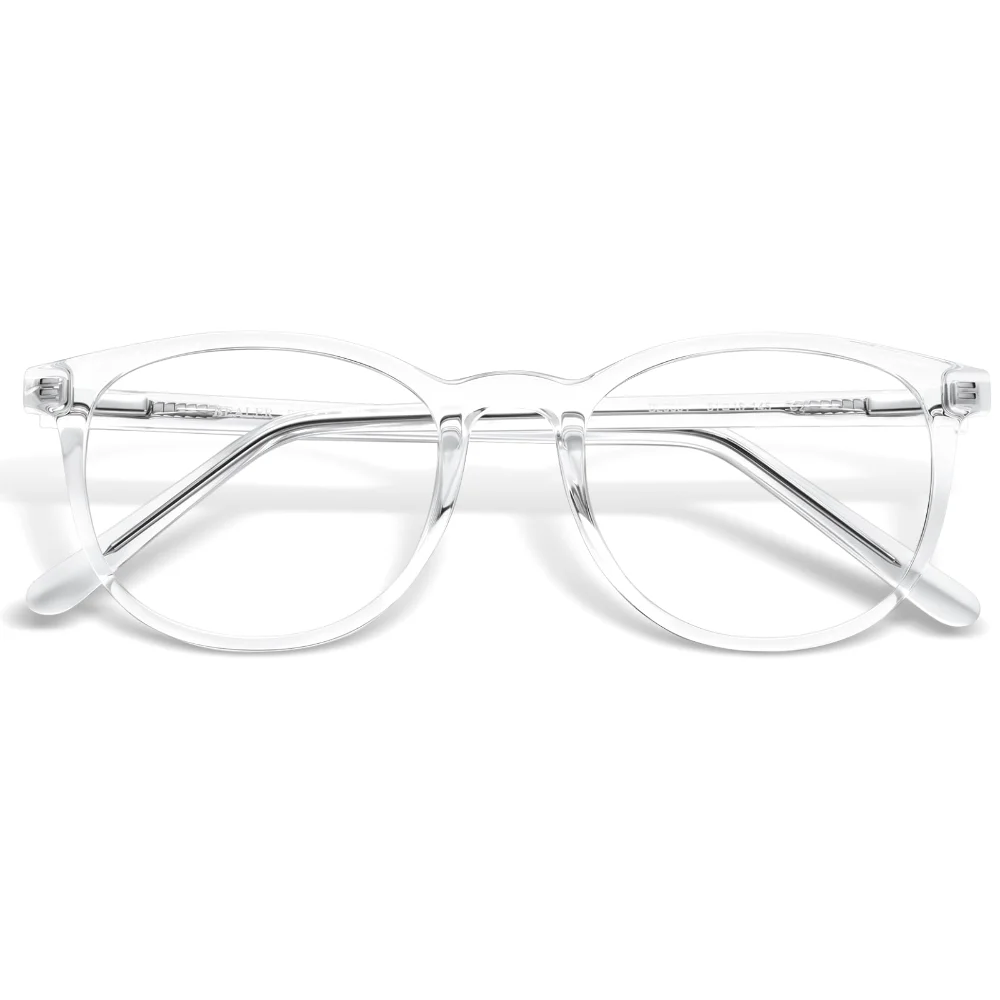
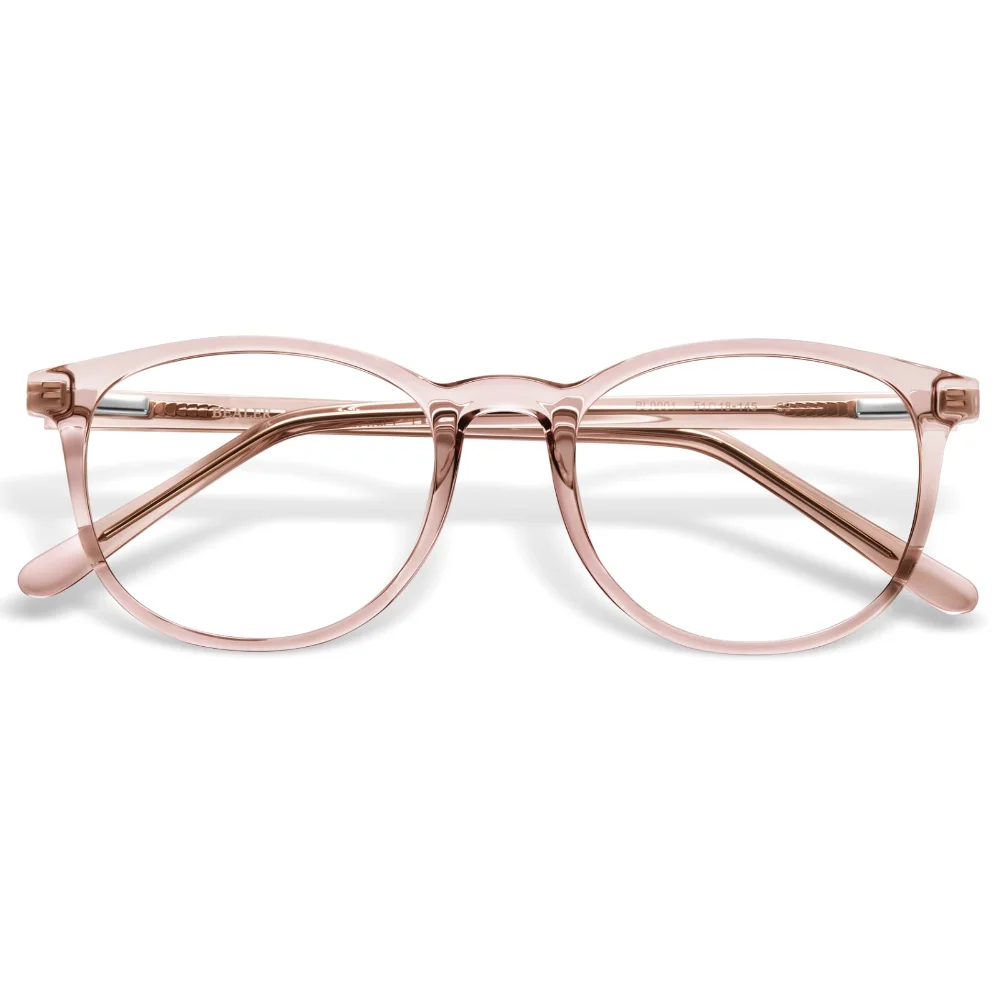
A clear 51 mm round lens in a 138 mm TR90 frame with a coating the brand rates for blue light. The academy of ophthalmology says nobody needs that coating; the frame is light, round and $9.99, and that is the case for it.
Round screen glasses
4.5 · 55 ratings
Round screen glasses
4.5 · 55 ratings
The screen shelf, with what the academy saysRead the blue light guide
11By the name people type
Ten pages, each one a slice of the catalogue laid out by frame width, lens colour and price. If you already know what you want from BEALER, start here rather than at a shelf.
Every sunglass lens the brand makes carries two separate things, a polarizing TAC film and a UV400 rating, and the card prints both. Thirty-two pairs and packs across three frame sizes, 62, 52 and 45 mm, from $9.99.
All 32, by frame and lens →The BL6608 is the frame the brand is known for: a 62 mm polarized lens wrapped in 137 mm of TR90 nylon with a 123 mm arm that grips rather than rests. Twelve hundred people have rated it. Grey, blue, green, orange or brown, $11.99 a pair or two for $19.99.
All 12, by frame and lens →A 52 mm rectangle whose lens comes up to the brow, so the sky stays out of the windscreen. Polycarbonate frame, metal hinges, gradient brown and tortoise in six single colourways at $9.99 and five three-packs at $15.99.
All 11, by frame and lens →A 45 mm lens in a frame that bends flat and comes back, cut for ages three to nine and sold three to a box because a child loses one and sits on another. Nine colour sets, $9.99 to $11.99 a box, which is $3.33 to $4.00 a pair.
All 9, by frame and lens →A 51 mm clear round frame with a coating the brand rates for blue light, in three finishes at $9.99. The academy of ophthalmology says nobody needs that coating, and this page says so too; the frame is light, round and sits on a face for eight hours, and that is the case for it.
All 3, by frame and lens →12Before you pick a frame
Every frame here prints the same five numbers, and the fastest way to use them is to read the inside of a temple on a pair that already fits you. Most temples carry three: lens width, bridge, temple length.
The men's wrap is 62 mm, the women's rectangle 52, the screen glasses 51, the children's frame 45. A pair that already fits you is your reference: within two millimetres and the look will be the same, five or more and the frame reads as a different size on your face.
The number that decides whether a frame pinches your temples or floats. The wrap is 137 mm across, the rectangle 139, the round screen frame 138. Measure your own face at the temples with a ruler in a mirror and add nothing: the frame should match it, not exceed it.
The men's wrap sits on a 17 mm bridge, the rectangle on 16, the screen glasses on 18. A bridge that is too narrow perches the frame high and lets it slide; one that is too wide drops the lenses onto your cheeks. Read it off your current pair before anything else.
From hinge to the tip behind your ear: 123 mm on the sport wrap, which is short on purpose so the arm grips rather than rests, 138 on the rectangle, 145 on the screen glasses. Short arms hold on when you run; long arms disappear when you sit.
The wrap's lens is 37 mm tall, the rectangle's 42, the screen frame's 45. On water and snow the glare comes up as well as down, and a taller lens covers the cheekbone; at a desk, a taller lens is simply more of your view without a frame edge in it.
The 45 mm children's frame is cut for ages three to nine. It comes three to a box, so keep one in the car and one in the bag, and before each goes on a face bend the arms out and back once: soft thermoplastic returns, and a pair that does not is a pair to retire.
13Where a lens stops
Three of these shelves sit close to your eyes. Below is what the relevant authorities actually say, with a link to each, and what a lens does and does not do about it.
The two are separate properties, and the academy of ophthalmology says polarization on its own provides none. Every sunglass lens here carries both the polarizing film and a UV400 rating, and the card prints both, because a pair with one of them is doing half the job.
American Academy of Ophthalmology, read September 3, 2026The screen glasses carry a coating the brand rates for the blue band, and that is what we print. The academy says the blue light from a screen has never been shown to harm an eye and that blue-light glasses are not necessary; the tired feeling after a day at a monitor comes from blinking half as often, not from the colour of the light.
American Academy of Ophthalmology, read September 3, 2026US regulation requires every sunglass lens to survive a 5/8-inch steel ball dropped from 50 inches. The children's frame bends because of what it is made of, and a lens that has passed a drop test is a lens that passed a drop test. Neither word is unbreakable, and a pair that has been sat on gets looked over before it goes back on a face.
US Code of Federal Regulations, 21 CFR 801.410, read September 3, 2026Lens width and height, frame width, temple and bridge in millimetres, the frame material, the lens rating, the pack count and a price from our own update. Those are the figures you can hold a ruler against, and they are the ones this catalogue stakes its name on.
Every source named here is listed with the date we read it on our updates page.
14In their words
Real reviews of these frames from people who have lived with one a while, quoted as they were written. The useful ones are rarely enthusiastic; they tell you which lens popped out, which mirror fades at the edge, and whose head the frame was too small for.
★★★★★
After cataract surgery
The hubby had Cataract Surgery a few months ago and for the first time in his life he can wear real sunglasses! He especially needs sunglasses due to his extreme light sensitivity. In his old prescription glasses he always wore very dark transition lenses.
★★★★☆
Twins, two and a half
Sunglasses fit our 2.5 year old twins just a little bit big. They do stay on their heads. One of the glasses the lens popped out very quickly and went missing. The other two pairs are still standing! The girls love that the glasses are similar but not the same.
on BEALER Kids Flex BL8002 Three-Pack G2, Pink/Cyan, Cyan/Pink and Purple/Pink
★★★☆☆
The orange mirror, two-pack
fit good, but the orange mirror lens are not great as they are uneven from center to end - the colour fades out
on BEALER Sport Wrap BL6608 Two-Pack Z03, Matte Black/Grey and Matte Black/Orange
★★★★★
The polarization test card
The glasses are polarized. They have a test label that can only be seen with the polarized glasses. They significantly reduce brightness and have a snug fit.
★★☆☆☆
Too small for her head
Way too small for an average woman's head. I gave them to my kids but they were unimpressed by the bland colors. So, not good for adults and boring for kids. No win.
on BEALER Retro Rectangle Three-Pack A4, Matte Black, Brown Tortoise and Orange Tortoise
★★★★★
Morning sunrises
Comfortable to wear. Not heavy but not to light. I like how they are polarized. Helps with the morning sunrises.
on BEALER Retro Rectangle Three-Pack A6, Matte Black, Gradient Brown and Pink Mirrored
★★★☆☆
Over prescription glasses
While it works as a blue blocking light, it is not recommended to place over your own prescription glasses--just too heavy and leave marks on bridge of nose.
★★★☆☆
Two minutes in
They’re super cute but my daughter almost broke them within two minutes of her getting them. The title says flexible rubber but they’re more hard plastic than anything.
on BEALER Kids Flex BL8002 Three-Pack G2, Pink/Cyan, Cyan/Pink and Purple/Pink
★★★★★
A young teen
My daughter loves these. They are durable for a young teen, very lightweight and stylish. If she loses these, then I’m gonna have to purchase another pair!
15About the brand
Everything here starts from the same place: hard light stands between you and something you are trying to see, and the lens you put in the way decides what gets through.
Making eyewear since 2016, 10 years of it, in 35 pairs and packs across four shelves. The name is a surname too, and a search for it turns up a philosopher and a basketball player; the eyewear is the part with millimetres on it.
16Before you order
Fit, the two ratings on a lens, driving, the screen glasses, and where a BEALER order is actually placed.
Every card on this site carries a buying button, and every page has one at the bottom. The button opens the current price at our retail partner in a new tab; payment, delivery and returns happen there rather than here.
If you already know the frame, the button in the header opens the whole range at once. If you do not, the four shelves above sort it by who is wearing the pair and in what light.
Both, on every sunglass lens here: the men's wrap, the women's rectangle and the children's frame all carry a polarizing TAC film and a UV400 rating, and the card prints both. The screen glasses are the exception on purpose: a clear lens with a coating, no tint, no polarization, and no UV rating claimed for it.
The two properties are separate. The American Academy of Ophthalmology says polarization on its own provides no UV protection, which is why a lens with only one of them is half a lens. The sources are on our updates page.
Read the inside of a temple on a pair you already own and compare. The men's wrap is 62 mm across the lens and 137 mm across the frame on a 17 mm bridge; the women's rectangle is 52 and 139 on a 16 mm bridge; the round screen frame is 51 and 138 on an 18 mm bridge; the children's frame is a 45 mm lens cut for ages three to nine. Within two millimetres of your own pair and the fit will feel the same.
In daylight, yes: the film takes the glare off a wet road and the bonnet in front of you, and that is the situation it was made for. Two cautions come straight from the ophthalmologists. A polarized lens can make an LCD dashboard, a phone or a cash machine hard to read at certain angles, and it is the wrong lens for driving at night, when you need every bit of light there is.
The lens carries a coating the brand rates for blue light, and that is what we print. What it does for you is a different question, and the academy of ophthalmology is direct: the blue light from a screen has never been shown to harm an eye, and blue-light glasses are not necessary. The tired feeling at five o'clock comes from blinking about half as often at a monitor. We sell the frame as a light, clear, round frame with a coating, which is what it is.
The men's two-packs are $19.99 for two pairs of the same wrap in two lens colours, which is $9.99 a pair against $11.99 to $12.99 for one. The women's three-packs are $15.99 for three rectangles, $5.33 a pair. The children's frame only comes in threes, at $9.99 to $11.99 a box, so $3.33 to $4.00 a pair. Each card does that arithmetic for you.
It bends rather than snaps: the frame is a soft thermoplastic that folds flat and comes back. Bendable is not unbreakable, and one reviewer's three-year-old had a lens out of one pair within two minutes while the other two pairs in the box carried on. Three to a box is the honest answer to a child, and the box is $9.99 to $11.99.
17Worth reading first
Reading 62-17-123 off a temple, driving at dusk in a polarized lens, buying a child a pair that has to survive being sat on, choosing between grey and brown, and deciding whether screen glasses are for you at all.
The inside of almost every temple carries three numbers, and they are enough to know whether a frame you have never held will fit. Here is what each one measures, where to find it on your own pair, and how far off is too far.
Read it →A polarizing film turns a white lake back into water and makes a car dashboard go dark, and both happen for the same reason. What the ophthalmologists say it is good for, where it gets in the way, and why it is not UV protection.
Read it →Children spend more time in the sun than adults and the harm adds up over a lifetime, which is why the optometrists want them in sunglasses early. What the lens has to do, what the frame can and cannot survive, and how to check a pair that has been sat on.
Read it →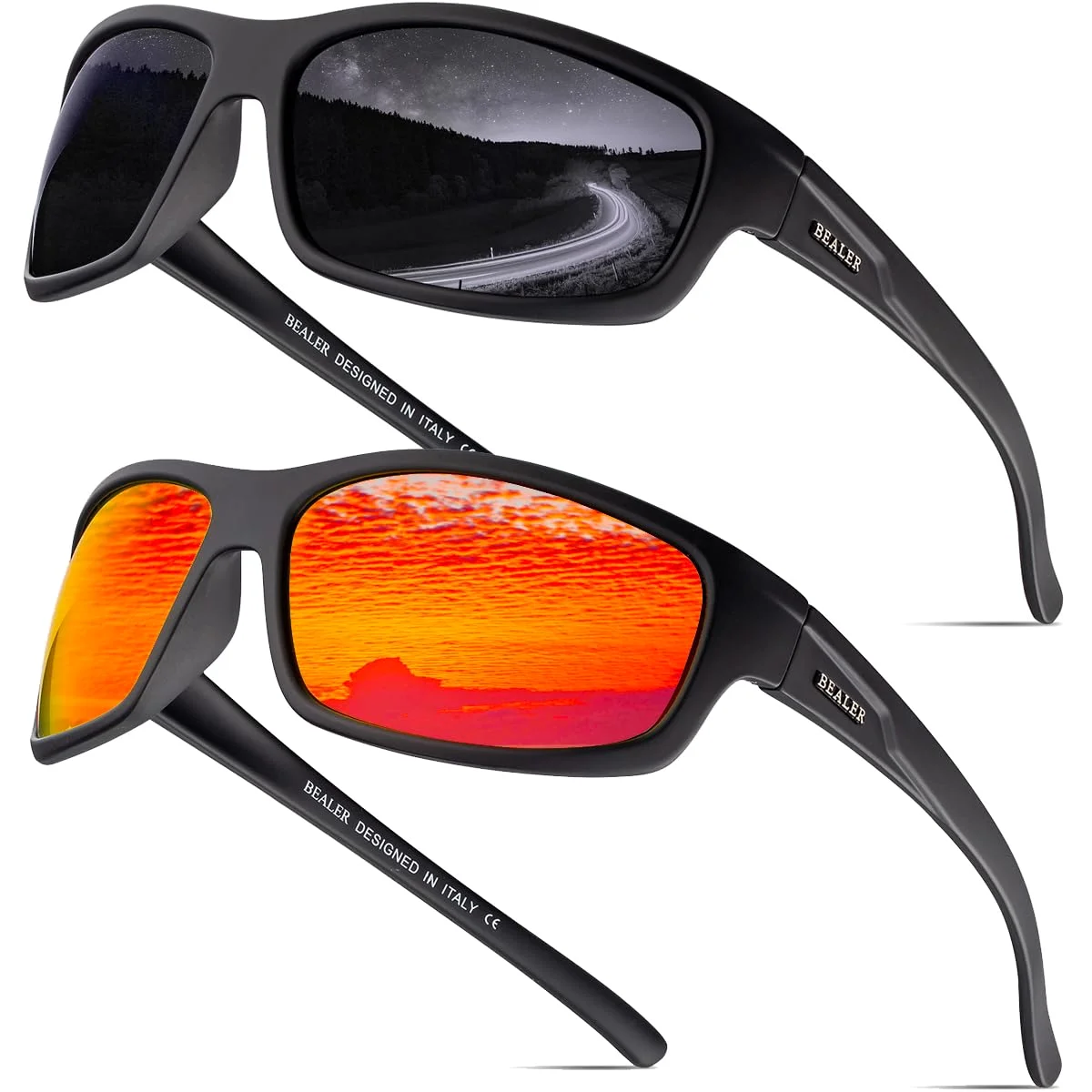
Lens colour is the one choice on a sunglass card that the UV rating does not settle for you. What each tint does to a road, a lake and a flat grey afternoon, and why darker is not safer.
Read it →We sell a frame with a blue-light coating and the ophthalmologists say nobody needs one. Both things are true, and this is the page that says how, including what a coating does, what it does not, and what makes your eyes tired at five o'clock.
Read it →One button, the whole BEALER range
Every lens colour, frame size and pack count in the BEALER catalogue sits behind this button, with the price from our last update beside it. Read the millimetres off a pair you already own, check them against the card, and the order goes through our retail partner.