BEALER: one lens, asked four different questions
BEALER has made eyewear since 2016, and the range makes more sense once you notice it is organised by who is squinting and at what, rather than by fashion season.
Stand on a jetty at noon and look down, and the water is not blue: it is white, a flat sheet of it, and the fish and the rocks under it are gone. Sit behind a windscreen at four in the afternoon and the road ahead does the same thing, a strip of light where the tarmac should be. Watch a three-year-old on a beach and she is squinting hard enough to close one eye. Sit at a monitor until five and your eyes feel like sand.
Those are four different problems with one thing in common: hard light stands between a person and what they are trying to look at. This range is four answers to it, and the honest thing to say first is that they are not equally good answers, because the four problems are not equally solvable with a lens.
What a polarized lens is actually doing#
Three of the four shelves carry the same core: a TAC lens, 1.1 mm thick, with a polarizing film laminated inside it and a UV400 rating. Those are two separate properties, and the distinction is the most useful thing on this site.
The film is a grid. Light that has bounced off a flat surface, water, a wet road, the bonnet of the car in front, arrives lined up in one plane, and the grid is tuned to stop exactly that plane while the rest of the sky comes through. That is why the lake turns from white to wet when you put the wrap on, and it is why the ophthalmologists list fishing, boating, beaches and snow as the places a polarized lens earns its keep. It is also why a car dashboard or a phone can go dark through the same lens at the wrong angle: a screen emits polarized light too, and the grid catches it.
The UV400 rating is the other property, and it has nothing to do with the film. It means the lens is built to stop wavelengths up to 400 nanometres, the top of the UVA band, which together with UVB is what reaches the ground. The American Academy of Ophthalmology says polarization on its own provides no UV protection and that a darker lens is not a safer one, so the number to read on any pair is the rating, and every card here prints it beside the word polarized rather than instead of it.
A polarizing film solves the view. A UV400 rating protects the eye. A lens with one of them is doing half the job.
Four frames, four kinds of day#
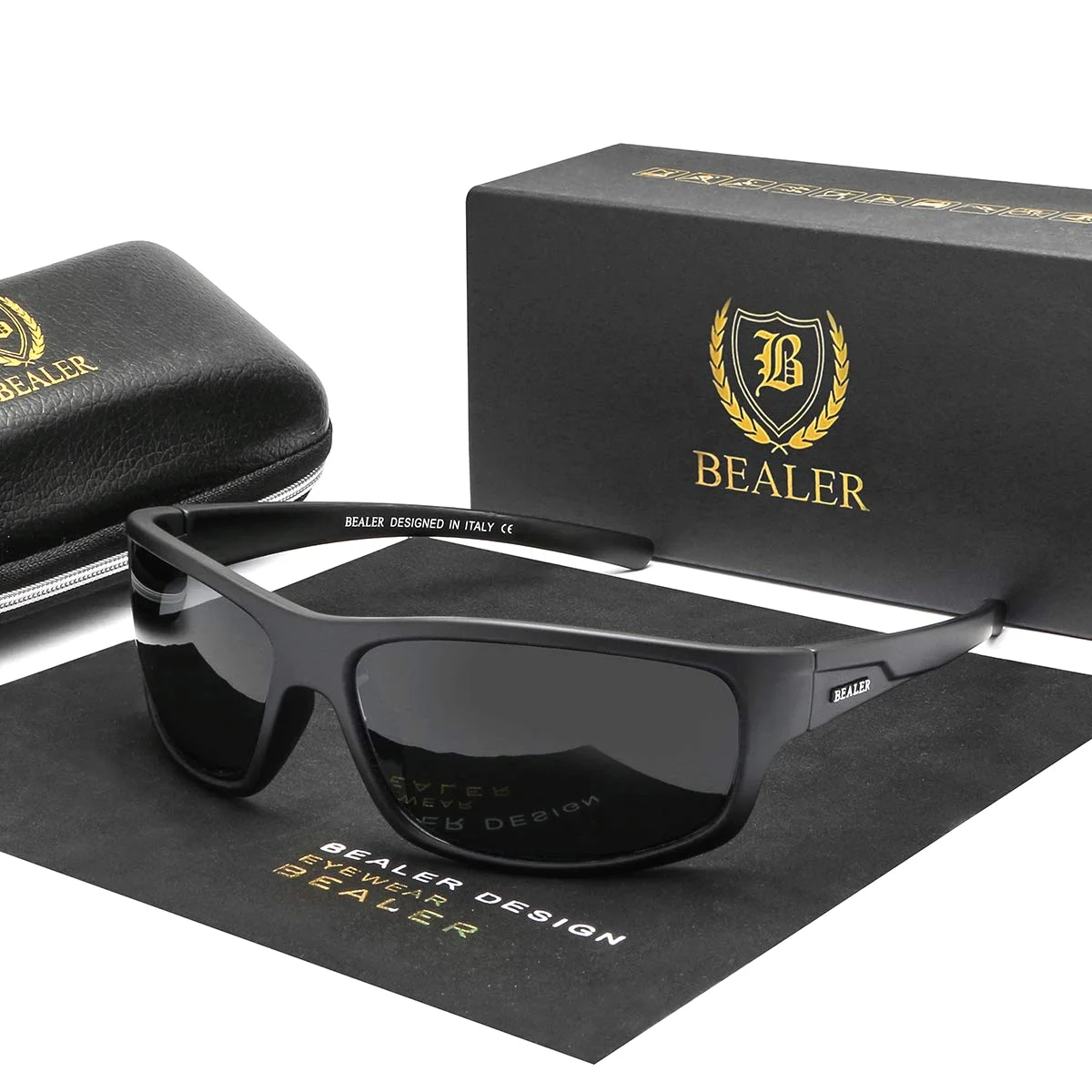
The BL6608 is the frame most people arrive through, with twelve hundred ratings behind it. It is a wrap: a 62 mm lens that curves back toward the temple to close the bright strip at the edge of your vision, in 137 mm of TR90 nylon with a 123 mm arm cut short so the tip grips the side of the head rather than resting on the ear. That is the right fit for a boat or a bike and a snug one for a wide face, and the reviews say both. It comes in five lens colours, grey first, and in two-packs at $9.99 a pair.
The women's rectangle is a different answer to a different light. Its lens is 42 mm tall, which is the number that keeps the sky out over the top edge when you drive, and most of the shelf carries a gradient brown that is darkest where the sky is. The frame is 139 mm of polycarbonate on a 16 mm bridge, a medium, and one reviewer with a wider face found it small; that review is on the front page, because a frame width you can check against a ruler is worth more than a compliment.
The children's frame is built around a sequence every parent knows: pulled off by one arm, dropped face down, sat on. It is a soft thermoplastic that bends flat and returns, with the same UV400 rating and polarizing film on a 45 mm lens, cut for ages three to nine and sold three to a box because a child loses one and sits on another. Bendable is the word we use for it. It is not the same word as unbreakable, and we do not use that one.
The shelf where the honest page and the sales page part ways#
The fourth frame is the BL9001, a round TR90 frame with a clear lens and a coating the brand rates for blue light. We print that rating because it is a property of the lens. We also print, on the same page, what the American Academy of Ophthalmology says about it: the small amount of blue light from a screen has never been shown to harm an eye, the evidence shows no meaningful link between blue light and damage to the retina, and blue-light glasses are not necessary. The tired feeling at the end of a day at a monitor comes from blinking about half as often, and the academy's fix is to look away from the screen, not to put a coating in front of it.
So the screen glasses are sold here as what they are: a light, round, 138 mm frame with a 145 mm arm that sits on a face for eight hours, in a clear lens with a coating, for people who like the look of glasses and do not need correction. That is a smaller claim than the box makes. It is the one we can stand behind.
What the numbers on a card are for#
Every frame here prints five measurements in millimetres: lens width and height, frame width, bridge and temple. They are there so you can hold them against a pair that already fits you, because the inside of almost any temple carries three of them, and a frame within two millimetres of your own will sit the same way. The material is named because it decides what happens when you sit on the frame. The pack count is printed with the price per pair because the two-packs and three-packs are where most of the value in this range is, and division at a till is nobody's idea of a good time.
The price on every card comes from our own product data and is refreshed on a schedule; the date of the last update lives on one page, the updates page, and nowhere else, so it cannot go stale in twelve places at once.
Where a lens stops#
Three of these shelves sit close to your eyes, and it is worth being exact about what a lens does and does not do there. A UV400 rating stops ultraviolet light; it is not a treatment for light sensitivity, and sensitivity that arrived suddenly is a question for an optometrist. A polarizing film takes glare out of a view; it is the wrong lens for driving at night, when you need all the light there is. A blue-light coating reflects part of one band of visible light; it treats nothing. And a lens that has passed the drop-ball test US regulation requires of every sunglass lens has passed a drop-ball test, which is all that impact resistant means.
Where a sentence on this site touches the eye rather than the view, it is the sentence of the American Academy of Ophthalmology, the American Optometric Association, the CDC or the FDA, with a link and the date we read it. Those sources, and the date, are on the updates page. The rest of the site is millimetres, lens colours and prices, which are the things we actually know.
01Where to start
The four shelves BEALER is divided into
35 pairs and packs, sorted by who is wearing the pair and in what light, rather than by what the frame is made of.
02The brand, briefly
BEALER: questions people ask first
What the name covers, how long it has been on the market, why a search for it finds a philosopher, and what happens when a buying button is pressed.
What does BEALER make?
Eyewear, and a short list of it. A polarized sport wrap for men in TR90 nylon, a polarized retro rectangle for women in polycarbonate, a bendable polarized frame for children aged three to nine, and a clear round frame for screen work. Four shelves, thirty-five pairs and packs, every one of them printed with its millimetres.
How long has BEALER been around?
Since 2016. That is the one figure on this site we state about ourselves rather than about a lens, and it is there because you can check it.
Is BEALER the same as the people called Bealer in the search results?
No. The word is a surname as well as a brand, and a search for it turns up a philosopher, a blacksmith who wrote books, two doctors and a basketball player. None of them has anything to do with these frames. BEALER, in capitals, on a temple, is the eyewear brand, and this is its catalogue.
What are you paying for in a BEALER pair that a cheaper one lacks?
Two ratings on the same lens, mostly. A polarizing film and a UV400 rating are separate properties, and the academy of ophthalmology says the first provides none of the second; a great many cheap lenses have one or neither. Every sunglass lens here carries both, and after that the money goes into the frame material and the hinge.
Who is a BEALER frame for?
Anyone squinting. A man on a boat deck at noon, a woman behind a windscreen at four in the afternoon, a three-year-old on a beach, and someone at a desk who likes the look of a round frame and does not need correction. The range is organised by who is wearing it and in what light, and the shelves say so.
One button, the whole BEALER range
Every lens colour, frame size and pack count in the BEALER selection sits behind this button, with the price from our last update beside it. Read the millimetres off a pair you already own, check them against the card, and the order goes through our retail partner.