Sunglasses for a three-year-old: what the eye doctors ask for, and what a frame can do
Children spend more time in the sun than adults and the harm adds up over a lifetime, which is why the optometrists want them in sunglasses early. What the lens has to do, what the frame can and cannot survive, and how to check a pair that has been sat on.
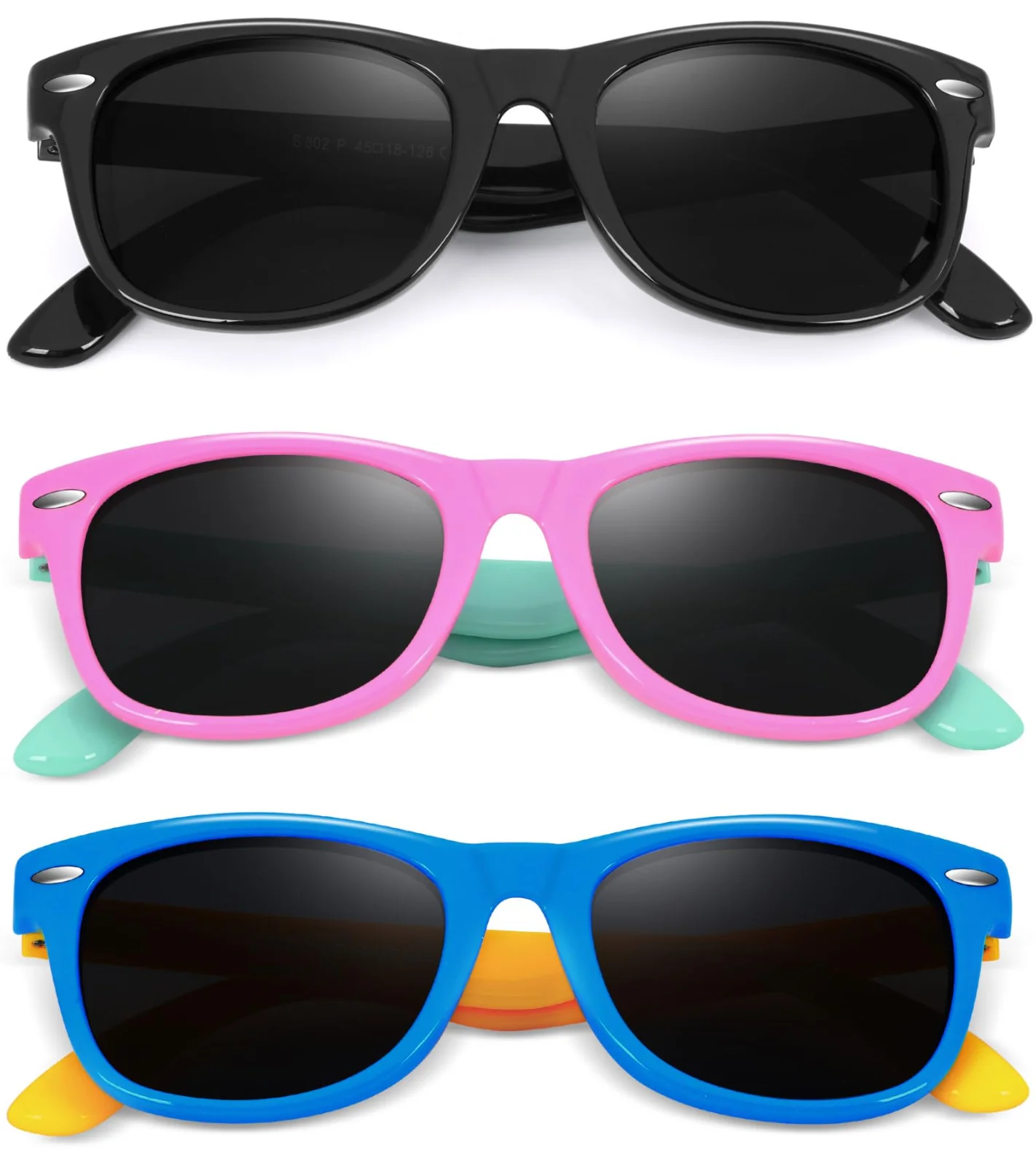
Watch a three-year-old on a beach at noon. She is squinting hard enough to close one eye, and in ten minutes she will have stopped noticing, because children adapt to discomfort faster than adults do and complain about it less. That is the whole problem with children and sun in one sentence: the eye that is being hurt is the one least likely to say so.
The American Optometric Association makes the case for children's sunglasses in one line that most parents have not heard: children typically spend more time in the sun than adults, and the damage from ultraviolet light is cumulative. The American Academy of Ophthalmology says it even more shortly. Babies and children need to wear hats and sunglasses for this very reason. Neither body is talking about a look. They are talking about a dose.
What the dose does#
Ultraviolet light does two kinds of harm to an eye, and the optometrists separate them. The short-term one is photokeratitis, which the AOA describes as like a sunburn of the eye: red eyes, a gritty feeling, extreme sensitivity to light, excessive tearing. It comes from a day on snow or water without protection and it passes, painfully.
The long-term one is the reason for the habit. The AOA's wording is that the longer the eyes are exposed to solar radiation, the greater the risk of developing cataracts, eye cancer, pterygium or macular degeneration later in life. The AAO's list is the same: cataracts and eye cancers, growths on the eye, snow blindness. Every one of those is a lifetime tally, and a child starts the count earlier and stands in the sun longer than the adult next to her.
The eye being hurt is the one least likely to say so. A child squints, then stops noticing.
What the lens has to do#
Two things, and they are separate. It has to stop ultraviolet, and the AAO's instruction for that is to look for a tag promising 100% UV protection or the marking UV400, which means the lens is built to stop wavelengths up to 400 nanometres, the top of the UVA band. And it may, as a second and optional matter, be polarized, which cuts the glare that bounces off wet sand and pool water and makes a child squint in the first place.
What it does not have to be is dark. The AAO says a darker lens is not a safer lens and that amber or grey tint will not necessarily block more sun than another colour. A very dark lens with no UV rating is the one thing worse than no lens: the pupil behind it opens wide and more ultraviolet gets in. So the number to read on a children's pair is the rating, and the tint is the part the child gets to choose.
The children's frame on this site carries both properties on a 45 mm lens: a UV400 rating and a polarizing TAC film. That is the card's claim, and it is the whole of it. Nothing about a lens rating makes a child safe in the sun for longer than she would otherwise be; the hat the academy mentions in the same breath is not optional either.
What the frame can survive, and what the words mean#
A child does not take glasses off. A child pulls them off by one arm, drops them face down, leaves them on a car seat and sits on them. A frame for a three-year-old is designed around that sequence or it is designed for the parent, and the material is the design.
The frame here is a soft thermoplastic, the brand's word is TPEE, that bends flat and returns. Fold the arms out past ninety degrees and they come back. Twist the bridge and it comes back. That is the property the box is built around, and the honest word for it is bendable. The word it is not is unbreakable, and the distinction is not pedantry: one reviewer's three-year-old had a lens out of one pair within two minutes of opening the box, while the other two pairs in the box carried on for the summer. Three to a box is the honest answer to a child. A promise about a frame is not.
The lens has its own rule, and it is federal. The FDA classes nonprescription sunglasses as Class I medical devices, and regulation 21 CFR 801.410 requires every sunglass lens to be impact resistant, with the referee test spelled out: a 5/8-inch steel ball weighing about 0.56 ounce, dropped from 50 inches onto the lens, which must not crack through or shed visible material. Nonprescription lenses are tested by statistically significant sampling of a batch rather than one by one. That test is what impact resistant means. It is a pass in a drop test, and it says nothing about a lens being sat on, stepped on, or thrown at a wall, so we do not either.
| The claim | Where it comes from | What it covers | What it does not |
|---|---|---|---|
| UV400 | A rating on the lens | Ultraviolet up to 400 nm, UVA and UVB | Brightness, glare, how long a child may stay out |
| Polarized | A film inside the lens | Glare off water, sand and snow | Ultraviolet; visibility at dusk |
| Bendable frame | The material, a soft thermoplastic | Arms and bridge that fold and return | A lens popping out of the rim; a pair being unbreakable |
| Impact resistant | 21 CFR 801.410, a drop-ball test | A steel ball from 50 inches, in a sample of the batch | Being sat on, stepped on, or thrown |
Fit, by age rather than by number#
Adult frames are sized in millimetres and a ruler settles the question. Children's frames are cut to an age band, and this one is cut for three to nine on a 45 mm lens with one frame size, which means the age band is the only sizing you get and the bend in the frame takes up the rest. Reviewers have it on two-and-a-half-year-old twins and describe it as a little big but staying on; on a nine-year-old it is at the small end.
The check that replaces the millimetres is a hand. Before the pair goes on, hold it by the arms and bend them out and back once. A soft frame returns to shape and sits square; a frame that stays bent, or that has a lens loose in its rim, is one to retire. Do the same thing after any afternoon that involved a car seat.
Three to a box, and why#
The children's frame here is only sold three at a time, in colour sets that do not match on purpose: a pink frame with cyan arms beside a cyan frame with pink arms beside a purple one, or black beside blue beside green. There are two reasons and both are practical. Two children in one family can tell their pairs apart across a table. And a pair will be lost, in the sand or under a seat, and the second and third in the box mean the afternoon carries on. A box is $9.99 to $11.99, which is $3.33 to $4.00 a pair.
When a pair of sunglasses is not the answer#
A child with a red, watering or light-sensitive eye needs an eye doctor rather than a darker lens, and a lens rating is not a treatment for any condition. One reviewer bought this frame for a daughter with a condition that makes light painful and found it helped her outdoors; that is a parent's account of a summer, not a medical claim, and it is not one this site will make for a lens. Where a child's eyes are concerned the people to ask are the optometrists and ophthalmologists whose guidance this whole page is written under, and both of them are linked below with the date we read them.
One button, the whole BEALER range
Every lens colour, frame size and pack count in the BEALER catalogue sits behind this button, with the price from our last update beside it. Read the millimetres off a pair you already own, check them against the card, and the order goes through our retail partner.