Grey, brown, orange or mirror: choosing a lens colour by the light you stand in
Lens colour is the one choice on a sunglass card that the UV rating does not settle for you. What each tint does to a road, a lake and a flat grey afternoon, and why darker is not safer.
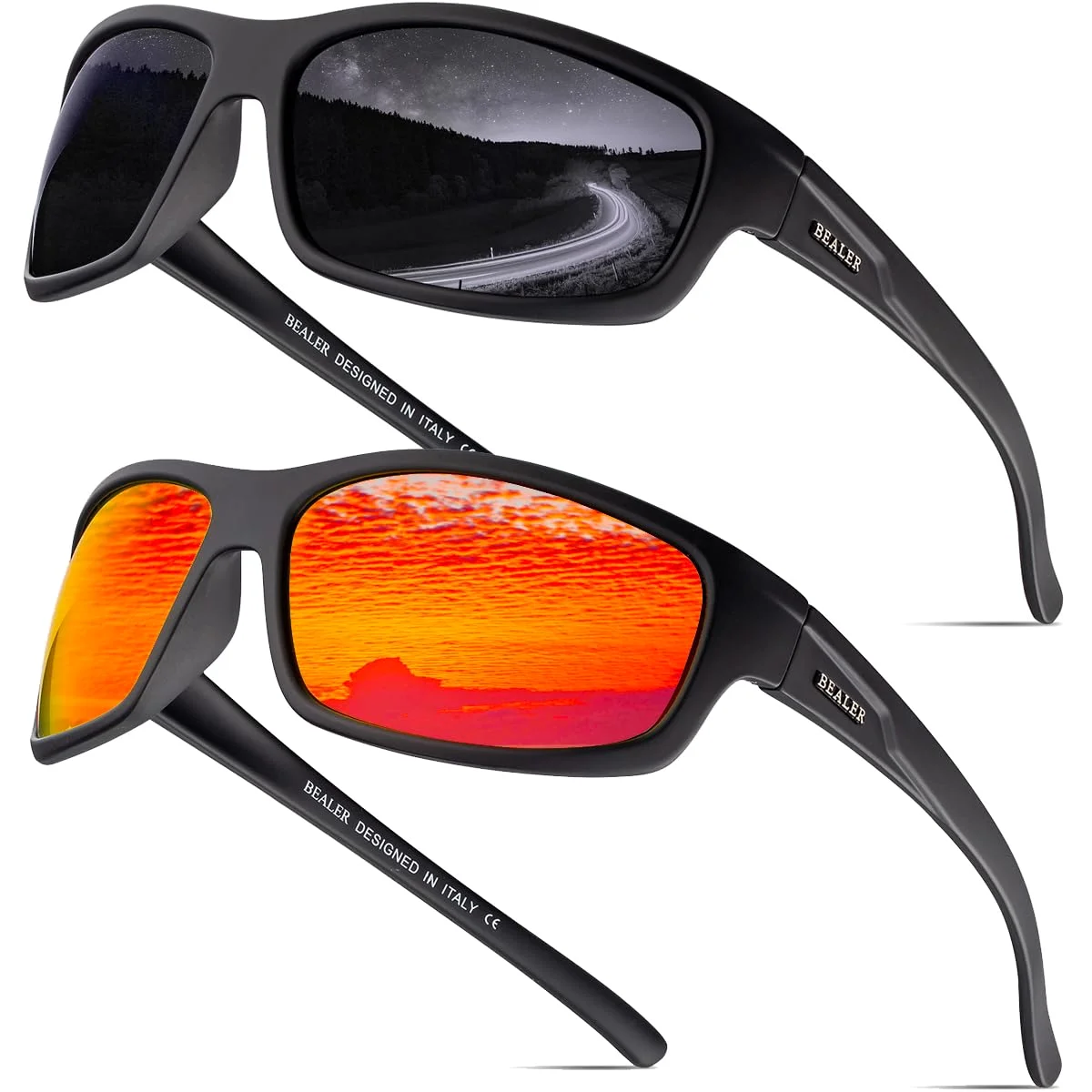
Put on a grey lens and the world is the same world, dimmer. Put on a brown lens and it is a warmer world with harder edges. Put on an orange lens on a flat overcast afternoon and the road you could barely see the shape of suddenly has a crown and two edges. None of those three lenses is protecting your eye any differently. All three are changing what you see, and that is the choice this page is about.
Two rules come first, from the ophthalmologists, because they settle what colour is not. The American Academy of Ophthalmology says sunglasses with coloured lenses, amber or grey, will not necessarily block out more sun than other lenses, and that a darker lens is not a more protective one. Ultraviolet protection is a rating on the lens, UV400 on every sunglass pair here, and it is the same whatever colour the tint is. So colour is about the view. Choose it that way.
Grey: the same world, dimmer#
Grey is a neutral tint. It takes visible light down evenly across the spectrum, so a red brake light stays red and a green sign stays green, and the American Optometric Association names it as the lens for proper colour recognition. That makes it the right first lens for almost everybody and the right only lens for anyone who drives a lot: behind a wheel, the colour of a light is information.
On this site grey is the lens on the men's sport wrap in both a matte and a glossy black frame, the lens on the orange tortoise women's rectangle, and the lens on every children's pair. The men's lens is rated to absorb 85% of visible light, which sits inside the 75 to 90% band the AOA gives for a sunglass lens, and it is the one that stays useful from nine in the morning to the last hour before dusk.
Brown and gradient brown: a warmer world with edges#
A brown tint absorbs more of the blue end of the spectrum than a grey one does, and the effect on the view is that shadows come forward and the edge between a road and a verge sharpens. The academy notes that some colours, brown and rose among them, offer contrast benefits for sport, and the same thing is true of a country road at four o'clock. Colours shift warm; a white car looks cream. For a driver who wants to see the lane rather than judge a paint colour, that is a good trade.
A gradient brown is a brown lens that is darker at the top than the bottom, and it exists for one place: behind a windscreen. The brightness is in the sky, the dashboard is not, and a lens that is dark where the sky is and lighter where your hands are lets you read the instruments without lifting the glasses. Most of the women's rectangle on this site carries a gradient brown, and its 42 mm lens height is the other half of the same idea: the lens comes up to the brow so the sky does not leak in over the top edge.
Orange: for the day with no contrast in it#
An orange lens is a contrast lens taken further. It cuts most of the blue out of the view, and blue is what a flat, overcast, drizzling afternoon is made of: the road, the sky and the spray are all the same grey, and an orange lens pulls the three apart. On that day it is the best lens on the shelf. On a bright day on open water it is the worst, because it is brightening a scene that is already too bright.
The men's wrap carries an orange lens in a matte black frame, and one reviewer who bought it in a two-pack found the mirror uneven from the centre to the edge and rated the box three stars for it. That review is on the front page; a lens colour page that hid it would not be worth reading.
Mirror coats: the same grey, with a shield in front#
The blue and green lenses on the sport wrap are not blue and green tints. They are mirror coats laid over a grey base, and what a mirror coat does is reflect a share of the light before the tint ever gets to work on it. The result is a darker lens on a bright day, and a lens with a coloured face that the person opposite sees rather than your eyes.
That has a cost. On a day that clouds over, a mirrored lens goes dim faster than a plain grey, because the reflection does not stop when the sun does. It is a lens for open water at midday, which is why it sits on the wrap and nowhere else in the range, and why the two-packs put a mirror beside a plain grey rather than beside another mirror.
Pink mirror and clear: two different jobs#
The women's shelf carries a clear frame with a pink mirror, and the pink is doing the orange lens's job in a smaller dose: warming a flat scene and lifting the detail in shadow, with a mirror on the outside. It reads as a fashion lens and it is, but the film underneath is the same polarized, UV400-rated TAC as the rest of the shelf.
The clear lens on the screen glasses is a different object entirely. It has no tint, so it does nothing to brightness or glare outdoors, and it carries no UV rating of its own, so it is not a sunglass lens at all. What it has is a coating the brand rates for the blue band of visible light, and what that coating does for you is the subject of its own page here. Do not take a clear lens to the beach on the strength of a coating.
| Lens | Best light | Worst light | Where it is on the shelves |
|---|---|---|---|
| Grey | Any bright day; driving | Dusk, indoors | Sport wrap in two finishes, orange tortoise rectangle, all children's pairs |
| Gradient brown | Behind a windscreen; a bright road | Anywhere colour must be judged exactly | Most of the women's rectangles |
| Orange | Flat, overcast, drizzle | Full sun on water | Sport wrap, and the Z03 two-pack |
| Blue or green mirror | Open water at midday; snow | A day that clouds over | Sport wrap, and the Z02 and Z04 two-packs |
| Pink mirror | Flat light, shade | Full sun | Clear-frame rectangle, and two three-packs |
| Clear with a coating | A desk | Outdoors in sun: no tint, no UV rating | The three screen frames |
How to choose on a Tuesday#
If you only own one pair, own a grey one, in the frame that fits your face. If you drive at four in the afternoon most days, look at a gradient brown and a lens tall enough to keep the sky out. If you fish or sail, add a mirror for the bright days and keep the grey for the rest. If you live somewhere with a long grey autumn, an orange lens will earn its place on the shelf by November. And whichever tint you pick, read the rating beside it: the colour is the part you will notice on the first afternoon, and the UV400 is the part you never will.
One button, the whole BEALER range
Every lens colour, frame size and pack count in the BEALER selection sits behind this button, with the price from our last update beside it. Read the millimetres off a pair you already own, check them against the card, and the order goes through our retail partner.